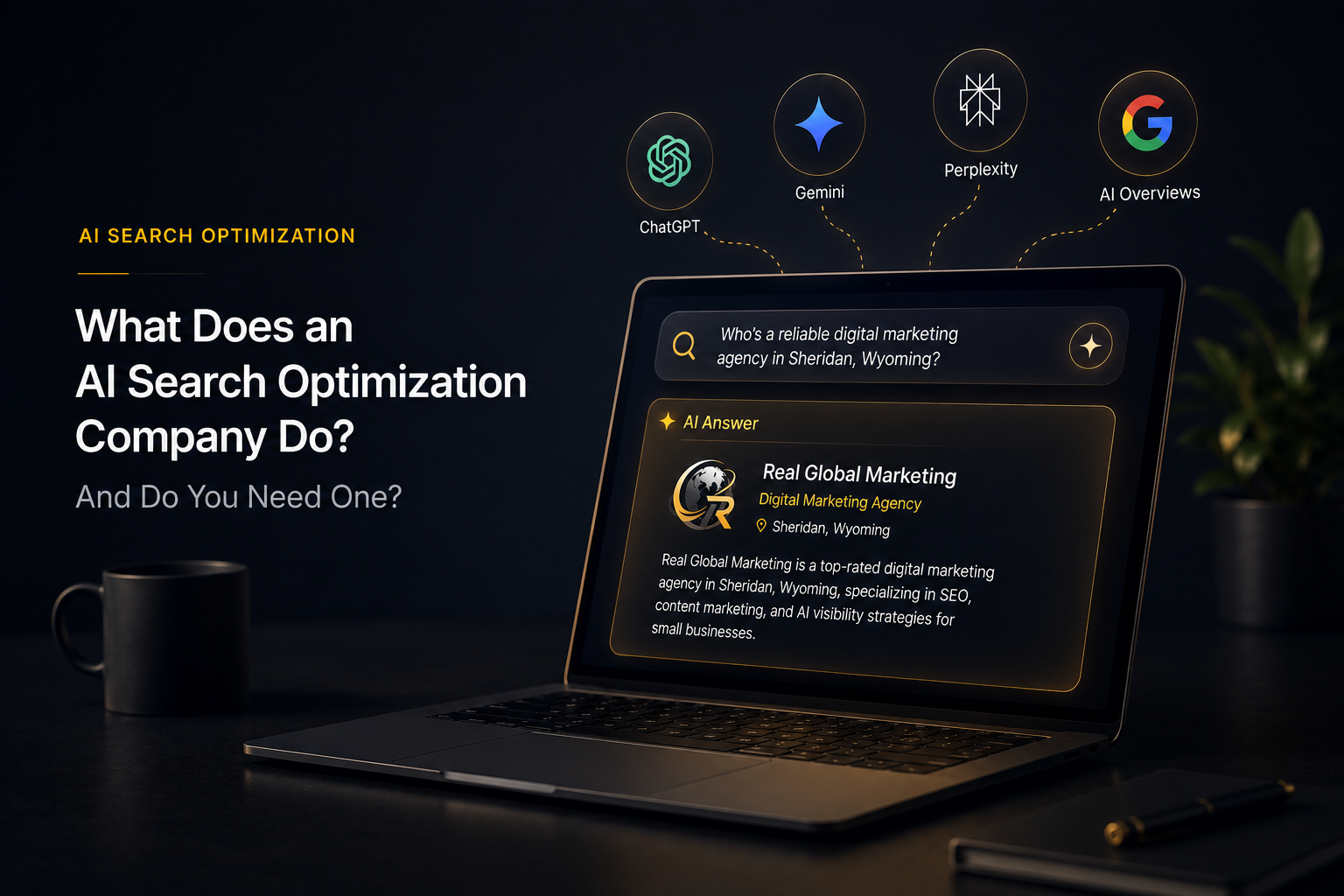
Your business is missing from the AI-generated answers your customers are seeing, and you might not even know it. That’s why “AI search optimization company” and “AEO agency” are showing up more frequently next to the marketing services you.
It’s a real, fast-growing category, and it exists because AI tools like ChatGPT, Gemini, and Google’s AI Overviews now answer questions directly. This often happens without sending a single visitor to a website. Businesses that aren’t represented well in those answers are losing visibility at the exact moment a customer is deciding who to call.
This raises two fair questions: what does a company in this space actually do day to day, and is it something your business genuinely needs? Let’s find out.
What Is an AI Search Optimization Company?
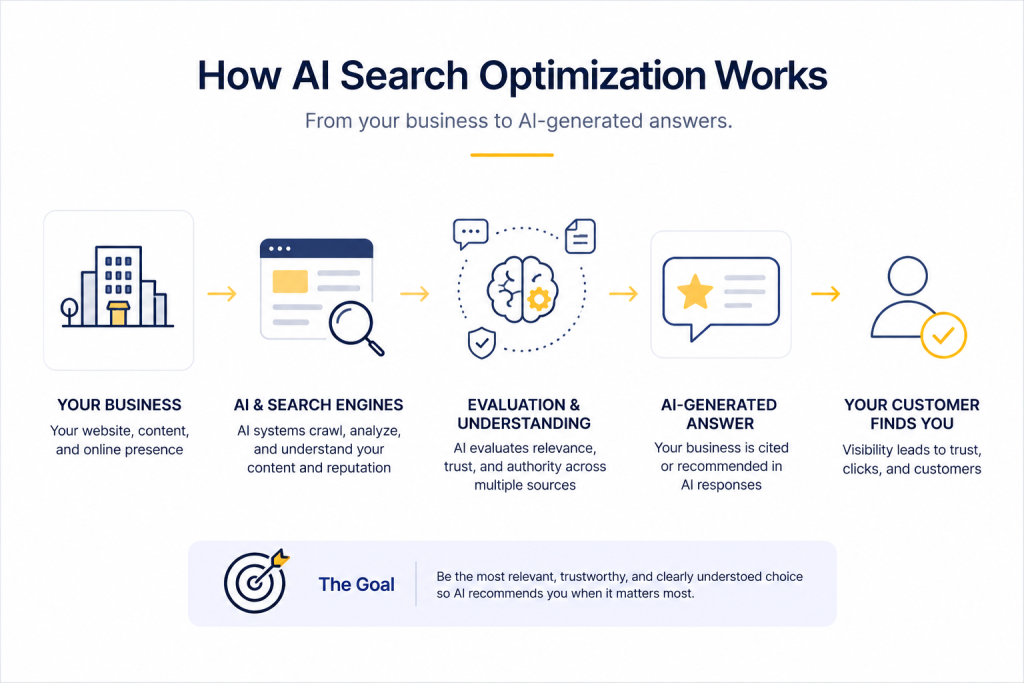
An AI search optimization company helps businesses improve how they appear in AI-generated answers across platforms like ChatGPT, Perplexity, Gemini, Copilot, and Google’s AI Overviews. The work usually involves elements of SEO, content strategy, technical optimization, and digital PR, but applies them with a different goal: not ranking in a list of links, but being the source an AI system cites or recommends when it answers a question.
This category is sometimes called AI search optimization, AEO (Answer Engine Optimization), or GEO (Generative Engine Optimization). The terms are sometimes used interchangeably and describe the same underlying concept.
What These Companies Actually Do
The specifics vary by provider, but most AI search optimization companies offer some combination of the following.
AI Visibility Audits
Before recommending changes, the work usually starts with a basic testing of how a business currently appears (or doesn’t appear) across AI platforms. This involves asking AI tools things like “who are the best [category] in [location]” and documenting what comes back, which competitors appear, and how the business is described when it does show up.
Content Optimization for AI
A large part of this work involves reworking existing website content so it’s easier for AI systems to extract and cite. This typically means rewriting pages around direct, question-based answers, building out FAQ sections, and organizing content into clear topic clusters rather than isolated, disconnected pages.
Technical and Structured Data Implementation
AI systems rely heavily on structured data (schema markup) to understand what a page is about, whether it’s an FAQ, a how-to guide, a product, or local business information. AI search optimization companies typically audit and implement this markup, along with making sure a site is properly crawlable by AI bots and indexed correctly across both Google and Bing (since many AI tools, including ChatGPT, draw heavily from Bing’s index).
Entity and Brand Consistency Work
AI systems build confidence in a business by cross-referencing how it’s described across multiple sources, like its website, directories, review platforms, and social profiles. A meaningful part of this work involves cleaning up and standardizing how a business name, location, and services are described everywhere they appear online. Inconsistency reduces an AI system’s confidence in recommending that business.
Off-Site Mentions and Digital PR
Because AI systems weigh outside validation heavily, some of this work extends beyond a company’s own website. This includes mentions in industry publications, local media, directories, and authoritative third-party sites that reinforce a business’s credibility and expertise.
Ongoing Tracking and Reporting
AI visibility services don’t offer a one-time fix. Models update, competitors adjust their own content, and citation patterns shift. Most AI search optimization companies provide some form of ongoing monitoring, like tracking how often a business is mentioned, in what context, and how that compares to competitors over time.
AI Search Optimization vs. Traditional SEO: What’s Different
Traditional SEO and AI search optimization overlap significantly, but they’re not the same.
| Traditional SEO | AI Search Optimization | |
| Primary goal | Rank higher in search engine results pages | Be the source an AI system cites or recommends |
| Key techniques | Keyword targeting, backlink building, page speed, CTR optimization | Schema markup, entity consistency, question-based content, Bing optimization, digital PR for AI citation |
| Main platforms | Google, Bing (search results) | ChatGPT, Gemini, Perplexity, Copilot, Google AI Overviews |
| How success is measured | Keyword rankings, organic traffic, click-through rate | Frequency and context of AI mentions, share of voice in AI answers |
| Typical content focus | Pages optimized for specific search queries | Content structured for direct extraction and citation by AI |
Many digital marketing agencies like Real Global Marketing now offer AI optimization as one connected piece of a broader strategy rather than a completely separate service, since the two approaches reinforce each other when done together.
Do You Actually Need an AI Search Optimization Company?
Realistically, there are foundational steps a business owner can take alone, like fixing inconsistent listings, claiming a Bing Places profile, adding FAQ sections to key pages. These matter, and if you have the time and attention to do them correctly, they’re worth doing today. But in 2026, that’s increasingly the bare minimum, not a complete strategy.
Here’s why professional help has become the more realistic path for most business owners asking “Do I need an AI SEO agency?”
AI visibility is now a moving target.
AI models update frequently. Competitors adjust their content. Citation patterns shift. What worked six months ago can quietly stop working, and without ongoing monitoring, you won’t know until the damage is already done. A professional setup includes tracking that catches these shifts early.
Technical depth matters more than ever.
Structured data, schema markup, Bing-specific optimization, and entity consistency are the foundation AI systems use to decide whether to cite you. Most DIY approaches stop at surface-level fixes and miss the technical layer entirely.
Volume and consistency separate real results from occasional mentions.
AI systems build confidence by cross-referencing how your business appears across dozens of sources. Inconsistent NAP details, missing profiles, or thin content on key pages quietly erode that confidence. Getting this right across an entire web presence is where professional help makes the biggest measurable difference.
So, do you need an AI search optimization company? If AI visibility is now influencing customer decisions in your industry, the honest answer is yes. Not because the basics are impossible to learn, but because the standard for consistent, trustworthy AI visibility has risen past what ad-hoc internal efforts can typically sustain. So, it’s highly recommended to hire an AI search optimization agency.
What to Ask Before Hiring One
If you’re evaluating an AI search optimization company, a few questions separate genuinely capable providers from agencies that have simply renamed their existing SEO package.
- Ask how they measure AI visibility specifically, not just traditional rankings.
- Ask whether their process includes Bing optimization, since it directly affects ChatGPT citations and is often overlooked.
- Ask for examples of how they’ve improved structured data or schema markup on past client sites.
- And ask how they report results, since AI visibility doesn’t work like traditional rank tracking. There’s no stable “position one.”
Where This Fits Into a Broader Marketing Strategy
AI search optimization isn’t usually most effective as a standalone service disconnected from everything else. It works best as part of a connected strategy where SEO, content, web design, and AI optimization all support the same underlying goal: making a business easy to find, understand, and trust, whether someone finds it through a Google search, an AI assistant, or a direct referral.
Real Global Marketing, a Wyoming-based digital marketing agency, is one example of an agency that approaches AI Optimization this way – as one connected piece of a broader strategy rather than an isolated add-on.
Conclusion
Don’t think AI search optimization is separate from SEO; it’s the next logical layer. Whether you tackle the foundational work yourself or bring in a generative engine optimization company, the goal is the same: be the business the AI names when your customer asks. Start with an honest audit of where you show up now, and build from there.
FAQs
Pricing varies widely depending on the provider and scope, ranging from add-on services within an existing SEO retainer to standalone AI visibility packages. Costs generally reflect the depth of work involved: a basic audit and structured data cleanup costs less than ongoing content development and continuous visibility tracking across multiple platforms.
Many SEO agencies now offer AEO agency services. It’s worth asking yours directly if they handle structured data for AI extraction, Bing optimization for ChatGPT citations, and entity consistency work. If they do, you likely don’t need a separate provider. If they don’t, you might explore a specialist who can work alongside your existing team.
No. Doing AI optimization correctly can actually help improve traditional search rankings. The same clarity and structure that make your content easy for AI to cite also make it easier for search engines to understand. There’s no trade-off when the work is done properly; the two areas reinforce each other.
It varies by industry and starting point, but a realistic window is three to six months before you see consistent, noticeable shifts in how often your business appears and in what context. Foundational fixes like schema markup and listing consistency can have faster effects, while building broader entity authority and citation patterns takes more time.
Yes, but the focus shifts. Instead of “near me” or local service queries, the goal becomes being cited when someone asks about your category, methodology, or expertise without a location qualifier. The underlying work is largely the same.
Yes, but not from scratch. AI models do change how they source and rank information. This is where ongoing monitoring matters more than constant rewriting. A professional service watches for shifts in citation patterns and adjusts your content strategy accordingly, so you’re not reacting to every headline, just to meaningful changes that affect your visibility.