AI SEO optimization, popularly known as Answer Engine Optimization (AEO) or generative engine optimization (GEO), is the practice of making your website, content, and entire online presence easier for AI systems to find, understand, and reference. Beyond ranking on Google, it ensures your business is cited by ChatGPT, Gemini, Perplexity, and every AI assistant your customers now use to find answers.
In 2026, this isn’t an advanced tactic. It’s the bare minimum for reaching the growing share of searchers who never click through to a single website. Here’s why that shift is happening and what it means for your visibility.
How AI SEO Optimization Works
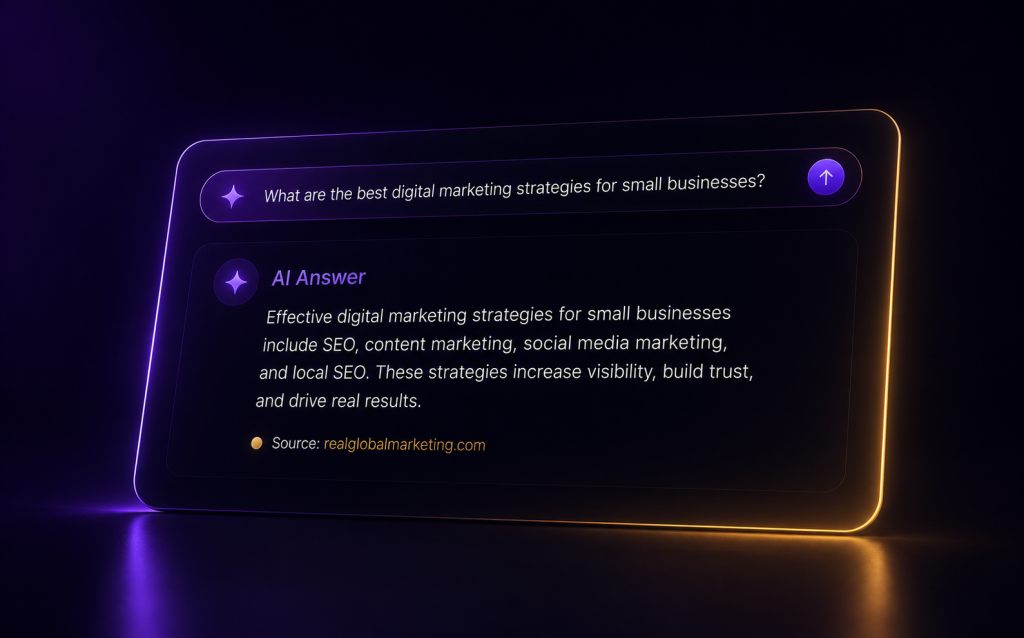
Traditional SEO was about ranking. The goal was a blue link on page one of Google. AI SEO optimization is about something different: becoming the answer. When someone asks ChatGPT “who are the best plumbers in Sheridan, Wyoming?” or Gemini “what should I look for in a digital marketing agency?”, the AI doesn’t return a list of ten links. It generates a direct response. It either cites your business or it doesn’t.
That’s the game now.
If your business isn’t structured, described, and validated in ways that AI models can easily digest, you simply won’t show up. Not in a link, not in a citation, not even in a footnote. The “bare minimum” you read above is exactly this: being the information an AI model reaches for when it gives an answer on your topic.
Here’s how that shift looks like for your online strategy:
| Old SEO | New SEO for AI Assistants (AEO) |
| “How do I rank number one on Google?” | “How do I become the source the AI trusts enough to cite by name?” |
Why AI SEO Optimization Can’t Wait in 2026
The search behavior you built your organic strategy around is disappearing fast. Google’s own AI Overviews now answer informational questions right on the top of the results page. Meanwhile, millions of users have replaced typed searches entirely with conversational prompts inside ChatGPT, Gemini, and Perplexity.
The numbers tell the story clearly.
- Over 68% of Google searches now end without a single click.
- ChatGPT alone crossed 900 million weekly active users.
If you rank #1 organically but your content isn’t built for AI extraction, the AI Overview above your link still captures the attention. Being cited inside that overview, even without a click, becomes a brand trust signal that compounds over time. After this massive shift, your business no longer competes with other websites. It competes with the AI’s own synthesized answer.
The catch? Most businesses built their strategy for a search era that’s already gone.
SEO vs. AI SEO Optimization: What’s the Difference?
Traditional SEO and AI SEO optimization aren’t opposites. They’re different layers of the same goal: visibility. But they operate differently.
| The Difference | Traditional SEO | AI SEO optimization (LLM SEO) |
| Target | Search engine crawlers | Large language models (LLMs) and AI-powered answer systems |
| Focus | Keywords, backlinks, page speed, and ranking position. | Clarity, authority, structure, and context. |
| Metric that matters | Where you appear in a list of results | Whether the AI understands your business well enough to recommend or cite it |
Think of it this way: SEO gets you found. AI SEO optimization gets you chosen by the machine (AI) answering the question.
How to Optimize for ChatGPT Search and Other AI Systems
Optimizing for ChatGPT, Gemini, Perplexity, and Google’s AI Overviews follows a different logic than traditional SEO.
1. Structure Content Around Direct Answers
First of all, AI systems scan for clarity and explicit answers before uniqueness or storytelling. Pages that bury answers deep in paragraphs, or mix multiple intents in one article, are harder for AI to extract from, and less likely to be cited.
The Solution:
- Lead with the answer, then support it with depth.
- Use clear headings that mirror the actual questions your customers ask.
- Write in plain, conversational language.
2. Build Topic Clusters, Not Isolated Pages
AI models work best when topics are connected logically across a site. A single blog post on a subject doesn’t carry the same weight as a cluster of interlinked content that comprehensively covers a topic.
If your website signals depth and authority on a specific subject, AI systems are more likely to treat you as a trustworthy source to reference.
3. Implement Structured Data (Schema Markup)
Schema markup tells AI and search systems exactly what type of content is on your page, like FAQ, HowTo, business information, service details. This isn’t optional anymore.
FAQ, HowTo, Article, and LocalBusiness schemas are among the most important for AI search visibility in 2026.
4. Optimize for Bing (Yes, Bing)
This surprises a lot of business owners, but it matters more than you think. Over 87% of ChatGPT’s citations match Bing’s top search results. ChatGPT doesn’t have its own web index for live queries, it pulls from Bing.
That means submitting your sitemap to Bing Webmaster Tools and claiming your Bing Places listing can help improve your AI search visibility in ChatGPT.
5. Maintain NAP Consistency Everywhere
AI systems check your business information across multiple platforms to confirm that it is genuine. If your business name, address, and phone number differ across Google, Yelp, Facebook, and directories, even slightly, it reduces your trustworthiness score with AI systems.
So, maintaining NAP (name, address, phone number) consistency should be one of the main priorities for your business.
6. Earn Off-Site Mentions and Citations
AI models aren’t just reading your website. They’re reading everything written about you. Get mentioned in industry publications, local news, niche directories, and authoritative third-party sources. These can give the AI systems strong signals that your business is real, established, and worth recommending.
What AI Systems Are Looking For
Understanding how AI systems evaluate sources can help you make sense of what to prioritize.
Relevance: How well does your content match the full intent of a query. Not just the keywords, but the context and goal behind it?
Authority: Is your business consistently mentioned by credible outside sources? Do reviews, publications, and directories confirm your expertise?
Behavioral signals: For local queries to be specific, how often do people click, call, or engage with your listing? AI-powered local search reads these engagement signals.
Hyper-local context: For local businesses, mentioning specific neighborhoods, landmarks, and communities in your content gives AI systems the geographic signals they need to match you with local queries.
A business that clearly states it serves a specific city or region is far easier for AI to recommend in local searches.
AI SEO Optimization and Local Businesses
There’s a common assumption that AI search optimization is something only large brands need to worry about. The opposite is often true.
Local service businesses, like contractors, healthcare providers, legal professionals, restaurants, service companies, are exactly the types of businesses people ask AI assistants about.
- “Who’s a reliable electrician near me?”
- “What’s the best accountant in Wyoming?”
These are natural language queries that AI handles constantly, and the local businesses that have optimized for AI search visibility win those moments.
For small and mid-sized businesses, being specific actually works in your favor. AI systems are better at recommending a business that clearly states what it does, who it serves, and where it operates than a business with generic, keyword-stuffed content that could apply to anyone.
Is Your Business AI-Ready?
Real Global Marketing is a Wyoming-based digital marketing agency that offers AI Optimization as a core service. We help US businesses structure their online presence so AI tools can clearly understand what they do, who they serve, and why they’re worth recommending.
If you’re a business owner trying to understand whether your current website and content are positioned for AI search visibility, that’s exactly where this kind of audit starts. The gap between businesses being cited in AI answers and those being skipped entirely comes down to how well their digital presence is structured, not how big they are.
The Bottom Line
AI SEO optimization isn’t a replacement for what you’ve been doing; it’s the missing part you need in your strategy to be on top. Search behavior has split into two tracks: traditional keyword search and AI-generated answers. Businesses that only optimize for one of them are invisible to a growing share of their potential customers.
The goal hasn’t changed: be visible when someone is looking for what you offer. What’s changed is where that visibility now needs to exist.
Our team is here and ready to discuss your AI positioning and help you discover how to get found in AI overviews.
FAQs
No, but they work together. Most businesses need both. Traditional SEO keeps you visible in conventional search, while AI SEO optimization makes you visible in the AI-generated answers that now sit above those results.
No. AI SEO optimization is mostly about how your existing content is structured and how your online presence is organized across platforms. It involves improvements like clearer headings, FAQ sections, schema markup, consistent business information, and content that directly answers questions. Most businesses can implement these changes without rebuilding their site from scratch.
ChatGPT pulls primarily from Bing’s search index for live queries, then condenses the results into a direct answer. Businesses that rank in Bing’s top results, maintain consistent NAP, have answer-focused content, and earn mentions from authoritative sources are more likely to be cited. There’s no single ranking parameter.
Some improvements, like schema markup and fixing inconsistent business information, can positively influence AI visibility within weeks. Building topical authority through content clusters and earning off-site mentions takes longer, typically three to six months before measurable citation improvements appear.
Yes. They may even compete more easily than in traditional SEO. AI systems favor specificity and contextual relevance over domain size. A local business with clearly structured content that answers specific local questions can outperform a national brand in AI-generated local answers.
These terms are often used interchangeably and describe the same underlying discipline with slight emphasis differences. AIO (AI Optimization) is the broadest term – optimizing for AI systems generally. AEO (Answer Engine Optimization) emphasizes optimizing for direct-answer formats. GEO (Generative Engine Optimization) focuses specifically on AI systems that generate synthesized responses. In practice, the strategies overlap significantly.
No. The improvements work together and benefit each other. Direct-answer content structure, schema markup, FAQ sections, and factual specificity all improve Google’s ability to understand and rank your pages alongside improving your AI citation rate. Optimizing for ChatGPT search visibility simultaneously strengthens traditional Google rankings.
Any business where customers ask research questions before making a purchase decision. Service businesses (legal, medical, home services, marketing), local businesses competing for city-specific queries, and any brand in a category where people ask AI assistants for recommendations. If someone could reasonably ask an AI “who should I use for X in Y location?”, AI SEO optimization is directly relevant to your business.