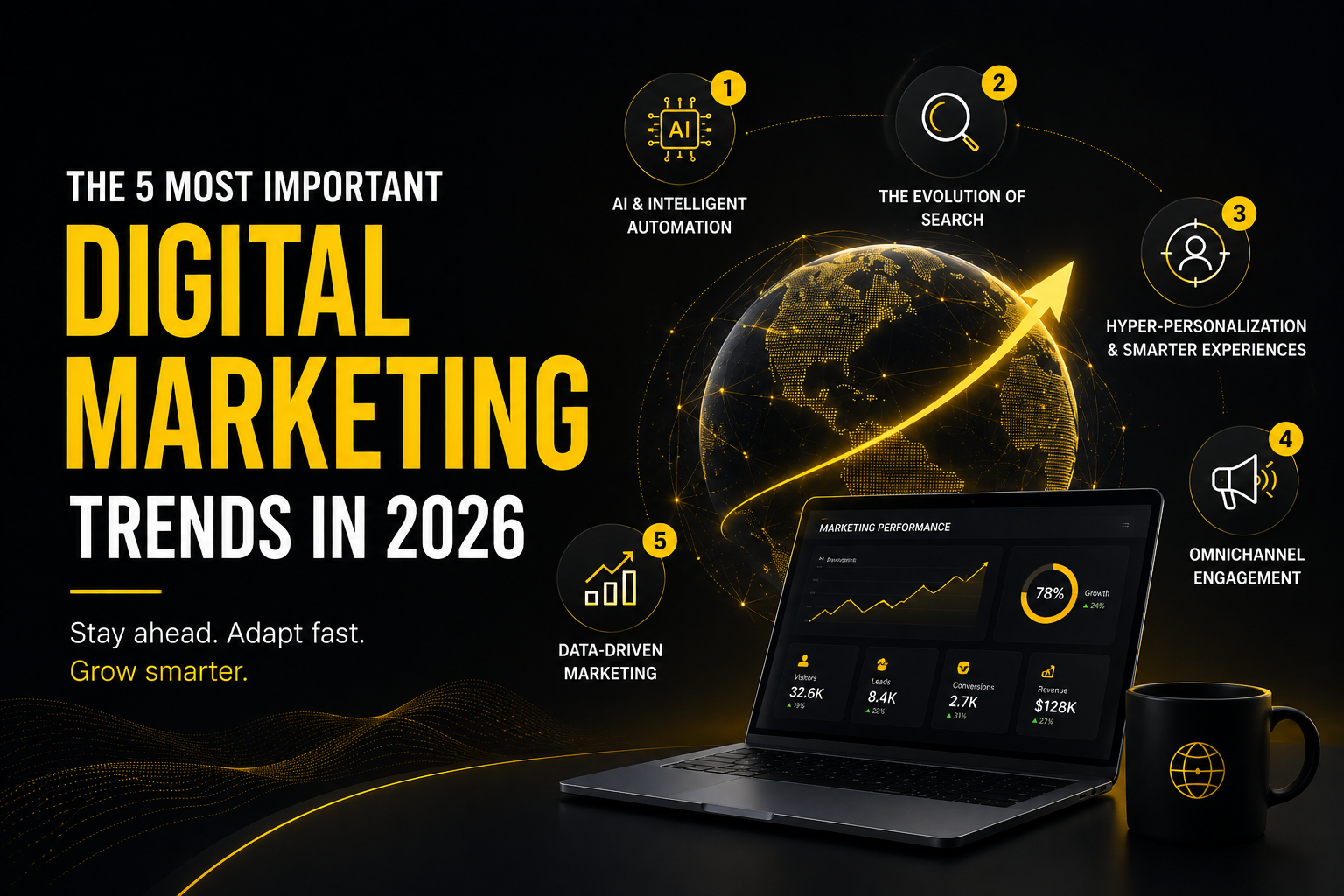
Digital marketing in 2026 is being reshaped by AI, changing search behavior, smarter automation, and increasingly fragmented customer journeys. For businesses, staying competitive means understanding which technologies and channels are actually changing how customers discover, evaluate, and interact with brands.
AI is at the center of this shift. It has moved beyond simple content generation and is becoming embedded in marketing platforms, search experiences, advertising systems, and customer interactions. At the same time, traditional SEO, content marketing, paid advertising, and social media are evolving alongside it.
So, what are the most important digital marketing trends in 2026? This guide explores five major shifts, from AI agents and AI-powered search to original content, creative-led advertising, and community-driven social media, and what they mean for businesses.
What Are the Key AI Trends Shaping Digital Marketing in 2026?
AI in 2026 is shifting from simple content generation to intelligent automation that drives real business results. Last year, marketers focused on discovering AI tools like ChatGPT and Gemini. This year, the focus is on using AI strategically to improve customer retention, increase revenue, boost ROI, and automate marketing workflows at scale.
As AI becomes more deeply integrated into everyday business operations, marketers are moving beyond experimentation and using it to make faster, smarter, and more data-driven decisions. One of the biggest trends leading this transformation is the rise of AI agents.
Autonomous AI Agents
AI agents are intelligent systems that go beyond following instructions. They can make decisions, take action, learn from data, and continuously optimize tasks with minimal human intervention. For example, an AI-powered customer support agent can answer questions, troubleshoot product issues, reschedule orders, manage subscriptions, and deliver faster, more personalized customer experiences.
AI agents are also changing the way people search and shop. Instead of simply finding information, these systems can compare products, add items to a shopping cart, and even prepare purchases for final approval. As AI becomes more involved in customer journeys, businesses must optimize their content not only for people but also for AI systems that read, understand, and recommend information.
Expert Tip: Your content may be read by an AI agent before a human ever sees it. Use clear language, structured content, and the right balance of text and visuals to improve how AI understands and recommends your brand.
The Shift from Basic AI Automation to Strategic AI Elevation
AI is no longer just a tool for automating repetitive tasks, it’s becoming a strategic partner that helps marketers create better campaigns and deliver greater value. As AI adoption continues to grow, businesses are moving beyond basic automation and using AI to improve decision-making, creativity, and overall marketing performance.
According to McKinsey‘s 2025 State of AI survey, 88% of respondents said their organizations regularly use AI in at least one business function, up from 78% the previous year. However, most organizations are still experimenting or piloting AI, with only about one-third reporting that they have begun scaling AI programs across the organization. Today, AI supports marketing by streamlining campaign execution, analyzing data, personalizing content, coordinating cross-channel campaigns, and monitoring performance.
In 2026, the opportunity is to move from basic AI automation toward what we call AI elevation: using AI not only to automate tasks, but to improve decision-making, creativity, and strategic execution. The result is a shift from content volume toward content quality, originality, and strategic curation.
Expert Tip: Start by automating repetitive marketing workflows such as lead routing, reporting, data collection, and content distribution. As your needs become more sophisticated, you can explore AI-agent and workflow automation platforms capable of handling more complex processes.
Hyper-Personalization and the Rise of Conversational eCommerce
AI is transforming how businesses connect with customers by delivering highly personalized experiences across every digital touchpoint. In 2026, AI agents will become a primary interface between brands and consumers, making online shopping and product discovery faster, smarter, and more conversational. McKinsey research suggests AI-powered search could significantly reshape how consumers discover and evaluate products, with as much as $750 billion in U.S. revenue potentially flowing through AI-powered search by 2028.
Traditional chatbots are evolving into intelligent AI assistants. Instead of simply answering questions, AI-powered search experiences will understand user intent, guide shoppers to the most relevant products, and provide personalized recommendations based on their needs. Search bars will become smarter, helping users find exactly what they’re looking for while offering filters, comparisons, and tailored suggestions.
A great example is Vestiaire Collective, which has introduced AI-powered search capabilities that combine keyword searches with image recognition to help shoppers discover highly relevant products. The company has also explored personalized pricing recommendations and image-based product discovery.
Expert Tip: Focus on search intent rather than keywords alone. Treat AI prompts and search queries as signals of where customers are in their buying journey, then deliver the right content, comparisons, and offers to guide them toward a purchase.
What Are the Top SEO Trends in 2026?
SEO in 2026 is no longer just about ranking for individual keywords. Search engines increasingly evaluate whether content is useful, relevant, trustworthy, and aligned with the user’s intent. At the same time, AI-powered search experiences are changing how information is discovered and presented.
Businesses should therefore focus on strong technical SEO, helpful people-first content, clear evidence of expertise, structured data where appropriate, and a recognizable brand presence across the platforms their audiences use.
So, what SEO trends should every marketer and business focus on in 2026?
Brand Voice and Authority Matter More in AI Search
With the rise of zero-click searches and AI-generated answers, building a recognizable brand has become more important than ever. A consistent brand voice helps establish a recognizable identity and can reinforce your brand’s authority and credibility across channels. Instead of publishing generic content, businesses should create original research, expert insights, customer stories, videos, and unique perspectives that differentiate their brand.
Expert Tip: Focus on topics where your business has genuine expertise, and strengthen your content with original research, expert quotes, customer case studies, or branded videos that aren’t easily replicated by generic AI-generated content.
Deep Search Intent Alignment
Understanding search intent has always been important, but in 2026 marketers must optimize for both human users and AI-powered search engines. It’s no longer enough to ask, “What is my customer searching for?” You should also ask, “What information would an AI-powered search system need to understand and accurately represent my brand?”
Keep these principles in mind:
- Search engines prioritize relevance. Content must directly answer what users are looking for, not simply include target keywords.
- Search intent determines content format. Whether users need a blog, guide, video, webinar, or comparison page depends on their stage in the buying journey.
- Search intent evolves over time. User behavior changes, so regularly updating your content helps maintain rankings and relevance.
Expert Tip: Strengthen your first-party data by improving lead-generation forms, maintaining accurate CRM records, building permission-based email lists, and creating direct customer relationships. Separately, participate in relevant communities such as Reddit to understand the questions, language, and concerns your audience shares.
Strategic Implementation of Schema Markup
Structured data can help search engines understand the entities, relationships, and information presented on a page. It can also make eligible pages easier for search engines to interpret for supported search features. However, structured data is not a guaranteed ranking or AI Overview visibility mechanism. Google recommends implementing accurate, relevant structured data that reflects the visible content on the page.
In AI-driven search, the broader goal is not simply to add more schema, but to make the information on your website clear, consistent, and machine-readable where appropriate.
Expert Tip: AI tools can help generate, review, and troubleshoot JSON-LD markup, but always validate the output and make sure it accurately represents the visible content on the page. Structured data should support your SEO strategy—not replace strong content and technical SEO fundamentals.
What Are the Top Content Marketing Trends in 2026?
Content remains one of the most powerful tools for building trust, strengthening brand authority, and driving long-term business growth. With 92% of marketers saying content is a valuable business asset for driving long-term ROI. Forbes Advisor also reports an average return of $2.77 for every $1 spent on content marketing, although actual results vary significantly by business, strategy, and measurement method. In 2026, success will come from creating original, people-first content that provides genuine value rather than simply publishing more.
Original Content Will Outperform AI-Generated Content
The rise of AI-generated content, often referred to as “AI slop,” has flooded the internet with low-quality articles, images, and videos. While this content can attract views and engagement, it also increases misinformation and reduces consumer trust. Research from Kapwing found that more than 20% of videos recommended to new YouTube users were AI-generated “AI slop.” Its analysis identified 278 channels that were exclusively AI-generated and found that those channels had collectively accumulated around 63 billion views.
As AI-generated content becomes more common, businesses have a greater opportunity to stand out with authentic, creative, and human-led content. Google says its systems are designed to prioritize helpful, reliable, people-first content and encourages creators to demonstrate original information, expertise, and first-hand experience. AI remains a valuable tool for brainstorming and improving efficiency, but the strongest campaigns combine AI with human creativity, strategic thinking, and editorial oversight.
Expert Tip: Be transparent about how AI is used in your content. Always review AI-generated output for accuracy, bias, and quality before publishing, and keep human expertise at the center of every campaign.
Optimize Content for AI Search and Discovery
As AI-powered search continues to evolve, businesses must optimize content not only for search engines but also for AI discovery. Instead of focusing solely on keywords, create content that demonstrates expertise, answers user questions naturally, and offers unique insights that AI systems can confidently reference.
To improve visibility across Google Search and AI-powered platforms:
- Include original quotes from your team or industry experts.
- Strengthen E-E-A-T (Experience, Expertise, Authoritativeness, and Trustworthiness).
- Support content with expert insights, citations, and relevant statistics.
- Write in clear, natural language that answers user questions.
- Write clear, direct introductions that quickly establish what the page covers and answer the user’s core question.
- Build semantic relationships between related topics and pages.
- Use structured data (schema markup) to help AI interpret your content.
According to McKinsey & Company, 50% of Google searches already include AI summaries, with that figure expected to reach more than 75% by 2028.
Expert Tip: Strengthen your brand alongside your SEO strategy. As AI-powered search changes how people discover information, recognizable brands with clear expertise and consistent information across the web have more opportunities to become trusted sources. Focus on original insights, consistent brand messaging, expert authorship, and credible third-party mentions.
What Are the Top Paid Marketing Trends in 2026?
Paid marketing is evolving rapidly as AI transforms how people discover products, interact with ads, and make purchasing decisions. In 2026, successful paid campaigns will rely on AI-powered automation, stronger creative assets, and smarter optimization. McKinsey’s 2025 AI Discovery Survey found that 44% of AI-powered search users consider it their primary source for digital insights, compared with 31% who say the same about traditional search engines.
Creative Assets Will Be Your Biggest Competitive Advantage
As AI automates audience targeting, bidding, placements, and campaign optimization, creative becomes one of the few factors marketers can still control. Platforms like Meta are expanding AI capabilities to automatically generate personalized ad variations, image backgrounds, and video enhancements, making it easier to scale campaigns.
But automation alone isn’t enough. High-quality visuals, compelling copy, and diverse creative formats remain essential for capturing attention and improving campaign performance. Businesses that continuously test new messaging and creative concepts will have a stronger advantage in competitive advertising environments.
Expert Tip: Create multiple versions of your ads using different headlines, visuals, captions, and formats. Regular A/B testing helps identify the creative combinations that generate the highest engagement and conversions.
AI Max Will Redefine Google Ads Optimization
AI Max is Google’s AI-powered optimization suite that uses Gemini and advanced machine learning to improve campaign performance. It automatically expands targeting based on search intent, generates creative variations, and optimizes ads to reach more qualified audiences with minimal manual effort.
To maximize results, regularly review your AI Max search terms report to identify irrelevant queries and add negative keywords before refining exact, phrase, or broad match targeting. Brands are already seeing significant results L’Oréal achieved a 2x higher conversion rate while reducing cost per conversion by 31%, unlocking new opportunities through AI-powered search intent.
Expert Tip: Take advantage of Google’s expanding AI-powered creative and campaign tools to test more variations of your advertising assets. But continue to evaluate creative performance using real conversion and revenue data rather than relying solely on platform-generated recommendations.
What Are the Top Social Media Trends in 2026?
Social media continues to be one of the most influential digital marketing channels. According to DataReportal’s Digital 2026 Global Overview Report, there were 5.66 billion active social media user identities worldwide as of October 2025, equivalent to 68.7% of the global population. The figure increased by 4.8% over the previous year, although DataReportal notes that user identities do not necessarily represent unique individuals.
Community-First Platforms Will Continue to Grow
In 2026, successful brands will focus less on chasing viral content and more on creating engaged communities. Platforms like Reddit, Discord, Substack, WhatsApp, Instagram Broadcast Channels, and TikTok Communities are becoming valuable spaces for real conversations and stronger customer relationships.
The growth speaks for itself. Reddit’s UK user base grew sharply, while Substack surpassed 5 million paid subscriptions in 2025. These platforms illustrate the broader shift toward communities where users actively participate in conversations rather than simply consume brand content.
These platforms allow brands to connect with audiences through genuine discussions rather than one-way marketing messages.
Expert Tip: Join conversations instead of controlling them. Adapt your tone, engage with comments, and communicate more naturally. Even B2B brands can build loyal communities by being approachable and authentic.
Authentic Content Will Outperform Polished Marketing
Social media users are posting less and consuming more meaningful content. Instead of polished promotional posts, audiences want behind-the-scenes stories, founder-led content, employee advocacy, and authentic experiences they can relate to.
Brands are responding by showcasing the people behind the business, sharing real customer stories, and embracing nostalgia-driven marketing. Founder-led brands such as Grace Beverley and Stephen Bartlett demonstrate how transparency and personal storytelling can strengthen audience trust and engagement. Employee-generated content also continues to build credibility by offering an authentic inside look at company culture.
Expert Tip: Create more behind-the-scenes videos, founder updates, and employee-generated content. Authentic storytelling consistently builds stronger engagement than highly polished promotional campaigns.
Influencer Marketing Is Evolving into the Creator Economy
Influencer marketing isn’t disappearing, it’s becoming more creator-driven and community-focused. According to Influencer Marketing Hub’s 2025 benchmark report, global social media advertising spend was projected to reach $266.92 billion in 2025, after social media surpassed paid search as the world’s largest advertising channel. Brands are now partnering with creators who produce trusted, engaging content instead of relying solely on celebrity influencers.
Major companies are already embracing this shift as witnessed during the 2026 FIFA World Cup. The Coca-Cola’s creator-focused strategy at the 2024 Paris Olympics was also a great example of this trend. This highlights how creators, public relations, and authentic storytelling are becoming central to modern marketing strategies.
Expert Tip: Invest in creator partnerships and digital PR together. As AI increasingly references trusted media sources, strong PR coverage and credible creator content can improve both brand visibility and long-term authority across search and social platforms.
Turn 2026 Digital Marketing Trends into Business Growth
The future of digital marketing is actively being shaped by AI, evolving search behaviors, authentic content, and smarter customer experiences. Winning in 2026 isn’t about blindly adopting new technologies, but strategically using them to create value, boost efficiency, and build deeper audience connections. The greatest growth opportunity lies in treating AI as a powerful strategic assistant rather than a human replacement, letting AI automate repetitive workflows so your team can focus on creativity, high-level strategy, and exceptional client experiences.
At Real Global Marketing, we help businesses turn these emerging trends into measurable growth. As a trusted US digital marketing agency, we deliver SEO, AI search optimization, paid advertising, content marketing, social media, and web design strategies designed to increase visibility, attract qualified leads, and support sustainable business growth.
FAQs
1. How does AI Search Optimization (GEO) differ from traditional SEO?
Generative Engine Optimization (GEO) focuses on improving how AI-powered search systems understand, retrieve, summarize, and potentially reference information about a brand. Traditional SEO focuses more broadly on helping web pages become discoverable, relevant, and competitive in search engine results.
2. Why is first-party data critical for marketing success in 2026?
First-party data is increasingly valuable because it gives businesses direct information about their customers and prospects. Data from CRM systems, email lists, lead forms, website interactions, and customer transactions can support personalization, audience segmentation, measurement, and better marketing decisions while reducing dependence on third-party tracking.
3. What is the difference between an AI chatbot and an autonomous AI agent?
A traditional chatbot is generally designed to handle conversations within a defined set of tasks or capabilities. An autonomous AI agent can go further by planning and executing multiple steps, using tools and data to complete tasks with greater independence, for example, troubleshooting an issue, updating a CRM record, or managing a multi-step workflow.
4. How can businesses protect their brand authority against “AI slop” and content saturation?
Brands can stand out from low-quality AI content by building strong E-E-A-T signals, publishing proprietary research, featuring verified human experts, sharing real customer case studies, and establishing an authentic brand voice across video and community platforms.
5. How do community-first social platforms contribute to B2B and B2C revenue?
Platforms such as Reddit, Discord, and Substack can give B2B and B2C brands access to niche communities where customers actively discuss problems, products, and recommendations. Participating authentically can help businesses build trust, understand customer needs, and strengthen brand relationships,especially when the goal is meaningful engagement rather than simply increasing reach.