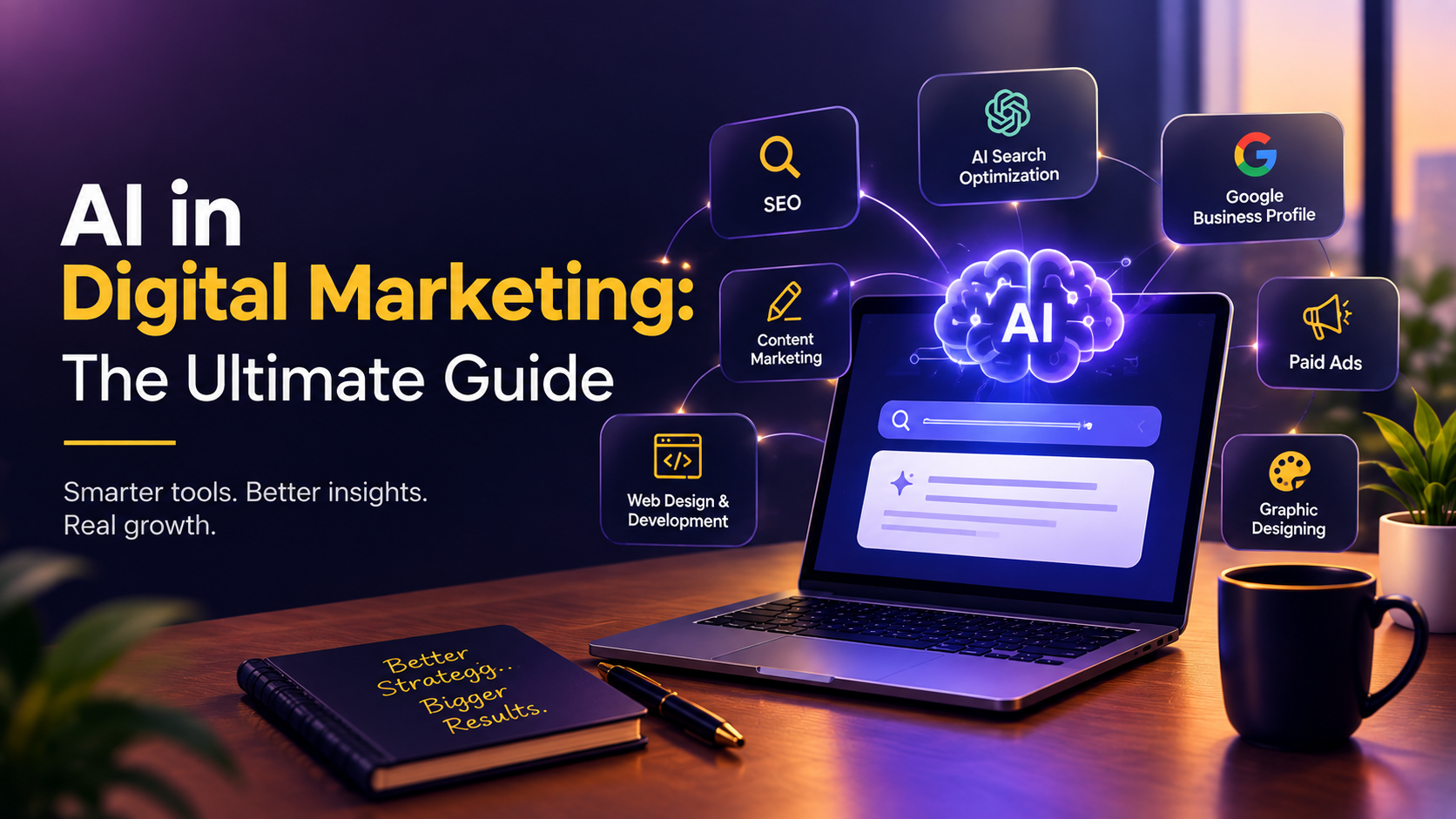
Artificial intelligence (AI) in digital marketing is no longer a futuristic concept, it’s transforming how businesses attract customers, create content, and drive growth. From personalized customer experiences and predictive analytics to smarter advertising and marketing automation, AI has become one of the most powerful tools in modern digital marketing.
In this 2026 guide, you’ll discover what AI in digital marketing is, how it’s transforming marketing, real-world use cases, the best AI tools, common challenges, and the essential skills needed to succeed in the AI-powered future.
How we developed this guide:
This guide combines current Google Search guidance, marketing research, and practical AI workflows used across content, SEO, paid advertising and marketing automation.
AI in SEO: What to Automate vs. What Humans Should Handle
| Task | Use AI? | Human involvement |
|---|---|---|
| Keyword clustering | Yes | Review |
| Search intent analysis | Yes | Essential |
| Content briefs | Yes | Essential |
| First draft | Yes | Heavy editing |
| Fact checking | AI-assisted | Mandatory |
| Original insights | No | Human |
| Expert opinion | No | Human |
| Internal linking suggestions | Yes | Review |
| Schema generation | Yes | Validate |
What Is AI in Digital Marketing?
AI in digital marketing is the use of artificial intelligence technologies such as machine learning, natural language processing (NLP), data analytics, and automation to help businesses understand customers, improve marketing performance, and make smarter decisions at scale.
Think about how much customer data businesses generate every day through websites, ads, emails, social media, and online searches. Analyzing that information manually would take countless hours. AI can process massive amounts of data in seconds, uncover customer behavior patterns, predict future actions, and deliver personalized experiences based on individual interests and preferences.
This allows marketers to send the right message to the right person at the right time. Whether it’s recommending products, personalizing email campaigns, optimizing ad targeting, or creating content, AI helps businesses improve efficiency while delivering more relevant customer experiences.
The business impact is already significant. According to the McKinsey Global Survey on AI, organizations are redesigning workflows, creating AI-focused leadership roles, retraining employees, and implementing AI governance frameworks to maximize the value of generative AI while managing potential risks. Companies are increasingly using AI to improve productivity, streamline operations, and drive measurable business growth.
Why Is AI Important in Digital Marketing?
AI in digital marketing is important because it helps businesses understand customers better, automate repetitive tasks, personalize marketing campaigns, and make faster, data-driven decisions. What started as simple machine learning algorithms has evolved into powerful AI systems that now shape how brands attract, engage, and convert customers online.
As the internet, eCommerce, and cloud computing evolved, businesses gained access to massive amounts of customer data. AI transformed that data into actionable insights, making it possible to deliver personalized recommendations, optimize advertising, improve conversion rates, forecast campaign performance, and enhance the overall customer experience. Today, AI has become one of the most influential technologies driving digital marketing success.
The Best AI Tools for Digital Marketing
| Tool | Best for | Key use |
|---|---|---|
| ChatGPT | Content & research | Ideation, analysis, drafting |
| Surfer | SEO | Content optimization |
| Mailchimp | Automation & personalization | |
| Zapier | Automation | Workflow automation |
| Midjourney | Visuals | Image generation |
| Tableau | Analytics | Data analysis & visualization |
Examples of AI in Digital Marketing
AI in digital marketing is transforming how businesses attract, engage, and retain customers across every digital channel. From content creation and social media marketing to customer service, advertising, and marketing automation, AI helps brands deliver more personalized experiences while improving efficiency and business performance.
One of the best examples is Sephora, which has used technologies such as virtual try-on and personalized digital experiences to help customers discover products online.
Another leading example is Netflix, which uses AI to personalize content recommendations for millions of users. Instead of showing the same homepage to everyone, Netflix analyzes thousands of data points, including:
- User profile information (age, location, language, etc.)
- Device used for streaming
- Viewing habits, such as pauses, rewinds, and fast-forwards
- Movies or TV shows completed
- Browsing and watch history
This personalization helps Netflix tailor the viewing experience to individual users and is an important part of how the platform surfaces content. These real-world examples show how AI helps businesses deliver smarter, more personalized digital experiences that drive long-term growth.
How Do You Use AI in Digital Marketing?
AI in digital marketing helps businesses create content faster, personalize customer experiences, automate repetitive tasks, and improve campaign performance using data-driven insights. From content creation and SEO to email marketing and paid advertising, AI has become an essential tool for marketers looking to save time while delivering better results.
Despite its growing adoption, many businesses are still in the early stages of implementation. For example, Capgemini’s research says almost 60% of organizations are integrating generative AI into marketing, with 37% actively implementing it across initiatives. This highlights a major opportunity for businesses that embrace AI as part of their digital marketing efforts.
1. Use Generative AI for Content and Image Creation
Creating high-quality marketing content consistently can be challenging, especially when teams manage multiple campaigns across different channels. Generative AI tools like ChatGPT and Claude help marketers produce blog articles, PPC ad copy, email subject lines, landing pages, product descriptions, social media captions, and more in a fraction of the time.
AI also makes it easier to personalize content, generate compelling headlines, support influencer marketing campaigns, and optimize content for Google AI Overviews and other AI-powered search experiences. While AI significantly improves efficiency and scalability, every piece of content should still be reviewed and refined to match your brand voice and maintain originality.
As marketing expert Mischa McInerney explains, AI is powerful because it’s cost-effective and highly scalable, but the best results come when it’s combined with human creativity, strategic thinking, and data-driven insights not used as a replacement for them.
2. AI-Powered Customer Service and Support
Customer expectations have changed. People no longer want to wait hours for an email reply or spend time navigating complicated support systems. They expect fast, accurate, and personalized assistance whenever they interact with a business. That’s where AI in digital marketing is making a significant impact.
AI-powered chatbots and virtual assistants can answer common questions, recommend products, book appointments, track orders, and provide 24/7 customer support without human intervention. Beyond simple conversations, AI analyzes customer behavior and previous interactions to deliver personalized responses, predict customer needs, and route complex issues to the right support team.
For example, an eCommerce store can use an AI chatbot to help customers find products, recommend related items based on browsing history, process returns, and answer shipping questions instantly. This creates a faster customer experience while allowing support teams to focus on more complex requests.
The importance of AI-driven customer support continues to grow. According to Mailchimp, 88% of marketers say they need to increase the use of automation and AI to meet customer expectations and remain competitive. Businesses that combine AI automation with human support can improve customer satisfaction, increase efficiency, and build stronger long-term relationships.
3. Understand Your Customers Better with AI
One of the biggest advantages of AI in digital marketing is its ability to understand customer behavior at a level that would be impossible through manual analysis. Instead of relying on assumptions, AI processes millions of data points to reveal what customers want, when they want it, and how they prefer to engage with your business.
AI automatically segments audiences based on demographics, interests, browsing behavior, purchase history, and buying intent. This allows businesses to create highly personalized marketing campaigns that adapt in real time rather than delivering the same message to everyone.
For example, platforms like Amazon recommend products based on previous purchases and browsing activity, while Netflix suggests movies and TV shows based on viewing history. Similarly, businesses can use AI to recommend products, personalize email campaigns, and display relevant offers that increase engagement and conversions.
AI also uses Natural Language Processing (NLP) to analyze customer reviews, social media conversations, surveys, and support tickets. This helps businesses identify customer sentiment, uncover common pain points, and discover new opportunities to improve products, services, and marketing campaigns.
To gain these insights, marketers use AI-powered platforms such as Salesforce Einstein, Optimove, and Segment. These tools combine customer data from multiple channels, predict future behavior, and help businesses deliver more personalized experiences that drive customer loyalty and long-term growth.
4. AI for Search Engine Optimization (SEO)
Search Engine Optimization (SEO) has changed dramatically with the rise of AI-powered search engines. Today, AI in digital marketing doesn’t just help businesses rank higher on Google, it also improves visibility across AI Overviews, AI search assistants, voice search, and visual search.
AI-powered SEO tools can automate keyword research, identify content gaps, optimize headings and meta descriptions, analyze competitors, and predict emerging search trends. Instead of focusing only on keywords, AI helps businesses create content that matches search intent and answers users’ questions more effectively.
For example, if a law firm wants to rank for “personal injury lawyer in Chicago,” AI tools can recommend related topics, optimize the page for semantic keywords, improve internal linking, generate schema markup, and identify opportunities to appear in Google’s AI Overviews. AI can also optimize images with descriptive metadata and help businesses create conversational content that performs better in voice search.
As search engines continue evolving, businesses that combine AI-powered SEO with high-quality, people-first content will have a much greater chance of earning organic traffic, qualified leads, and long-term search visibility.
5. AI for Pay-Per-Click (PPC) Advertising
AI in digital marketing is transforming Pay-Per-Click (PPC) advertising by making campaigns smarter, faster, and more profitable. Instead of relying on manual optimization, AI continuously analyzes campaign performance, audience behavior, and conversion data to improve results automatically.
Modern advertising platforms like Google Ads and Meta Ads already use AI to optimize audience targeting, bidding strategies, ad placements, and campaign performance in real time. This allows businesses to reach the right customers while reducing wasted ad spend.
AI can improve PPC campaigns by helping marketers:
- Identify high-intent audiences based on user behavior and purchase signals.
- Discover profitable keywords and emerging search trends.
- Generate high-converting ad headlines, descriptions, and creatives using generative AI.
- Create AI-powered images and ad assets directly within advertising platforms.
- Automatically adjust bidding strategies to maximize conversions or Return on Ad Spend (ROAS).
- Optimize product titles and descriptions for Google Shopping and eCommerce campaigns.
- Display ads at the most effective times and placements using predictive analysis.
- Run automated A/B testing to quickly identify winning ad variations.
- Generate real-time reports with actionable insights and performance recommendations.
- Forecast campaign performance before increasing advertising budgets.
- Help identify potentially invalid traffic and suspicious activity.
For example, an online furniture retailer can use AI to automatically identify high-converting audiences, generate multiple ad creatives, adjust bids throughout the day, personalised landing pages for different visitors, and continuously optimize campaigns based on conversion data. Instead of manually managing every campaign, marketers can focus on strategy while AI handles real-time optimization.
As AI advertising technology continues to evolve, businesses that embrace AI-powered PPC will be able to launch more efficient campaigns, reduce acquisition costs, and achieve better marketing ROI.
6. AI for Data Analytics and Business Insights
One of the biggest advantages of AI in digital marketing is its ability to turn massive amounts of data into actionable business insights. Every day, businesses collect data from websites, social media, email campaigns, CRM systems, and advertising platforms. Analyzing all of this manually is time-consuming, but AI can process it in seconds.
AI-powered analytics tools identify customer behavior, purchasing patterns, campaign performance, and emerging trends while predicting future outcomes. Instead of simply reporting what happened, AI helps businesses understand why it happened and what to do next.
For example, an online fashion retailer can use AI to discover which products are likely to sell next month, identify customers at risk of leaving, recommend personalized offers, and optimize inventory based on buying trends. AI can also detect unusual changes in campaign performance, allowing marketers to solve problems before they become expensive.
Tools like Google Analytics 4, Tableau, and Power BI can analyze spreadsheets, visualize complex datasets, identify hidden patterns, and generate easy-to-understand reports. By combining AI with data analytics, businesses can make smarter marketing decisions, improve customer experiences, and maximize return on investment (ROI).
7. AI for Email Marketing
Email marketing continues to deliver one of the highest returns on investment, and AI in digital marketing makes it even more effective. Instead of sending the same email to every subscriber, AI helps businesses deliver personalized messages at the right time, to the right audience, with the right content.
AI analyzes customer behavior, purchase history, website activity, and engagement patterns to automatically create highly targeted email campaigns. This increases open rates, click-through rates, and conversions while saving marketers valuable time.
For example, an online skincare brand can automatically send a welcome email when someone subscribes, recommend products based on previous purchases, remind customers about abandoned carts, and send personalized refill reminders when products are likely to run out all without manual effort.
AI can improve email marketing by helping businesses:
- Analyze email performance and identify the best-performing subject lines, content, and send times.
- Build automated workflows triggered by actions such as sign-ups, purchases, or abandoned carts.
- Generate personalized subject lines and email copy using generative AI.
- Deliver dynamic content and product recommendations based on customer behavior.
- Segment subscribers automatically for more targeted campaigns.
- Run AI-powered A/B tests to identify the highest-converting email variations.
- Remove inactive subscribers and maintain a healthier email list.
- Determine the ideal sending frequency based on individual engagement patterns.
Rather than replacing email marketers, AI helps them work more efficiently by automating repetitive tasks and uncovering opportunities to improve campaign performance. The result is more personalized customer communication, stronger relationships, and higher conversions.
What Are the Pros and Cons of AI in Digital Marketing?
Artificial Intelligence has transformed the way businesses market their products and services. From creating content and automating campaigns to analyzing customer behavior and predicting future trends, AI in digital marketing helps companies work smarter and grow faster. However, like any technology, AI has both advantages and limitations. Understanding both sides will help you use AI responsibly while maximizing its business value.
What Are the Pros of AI in Digital Marketing?
Businesses that use AI strategically can improve efficiency, reduce costs, and deliver better customer experiences. Some of the biggest advantages include:
- Increases productivity: AI automates repetitive tasks like content creation, reporting, customer segmentation, and campaign management, allowing marketing teams to focus on strategy and creativity.
- Improves efficiency: AI processes large volumes of data in seconds, helping businesses make faster and more informed marketing decisions.
- Provides valuable insights: AI uncovers customer behavior, market trends, and purchasing patterns that would be difficult to identify manually.
- Boosts ROI: Predictive analytics help businesses target the right audience, optimize campaigns, and increase conversions while reducing wasted marketing spend.
- Creates and optimizes content: AI assists with writing blogs, emails, ad copy, product descriptions, and SEO content while suggesting improvements for better search performance.
- Delivers personalization at scale: AI tailors product recommendations, email campaigns, website experiences, and advertisements based on individual customer preferences.
- Predicts future trends: By analyzing historical data, AI forecasts customer demand, buying behavior, and market changes, helping businesses plan ahead.
- Automates routine marketing tasks: From scheduling emails to generating reports and managing customer support, AI reduces manual work and improves operational efficiency.
What Are the Cons of AI in Digital Marketing?
While AI offers significant benefits, it still requires human oversight to ensure accuracy, fairness, and ethical use.
- Bias in AI models: AI learns from existing data, which may contain cultural, demographic, or societal biases that can influence marketing decisions.
- Inaccurate information: AI-generated content or analysis isn’t always correct. Businesses should always review and verify outputs before publishing or acting on them.
- Privacy and ethical concerns: AI often relies on customer data for personalization, making data privacy, user consent, and regulatory compliance essential.
- Data security risks: Marketing platforms store valuable customer information that must be protected against cyber threats and unauthorized access.
- Lack of transparency: As AI-generated content becomes more common, businesses should clearly disclose AI usage when appropriate and maintain originality and authenticity.
- Overdependence on automation: Relying entirely on AI can lead to generic content and missed opportunities for human creativity, emotional storytelling, and strategic thinking.
What Are the Most Important Skills for AI in Digital Marketing?
Using AI in digital marketing isn’t just about learning how to use ChatGPT or other AI tools. The real advantage comes from understanding when, where, and why to use AI to solve business problems, improve marketing performance, and create better customer experiences.
Businesses that successfully adopt AI don’t replace human marketers; they combine AI-powered automation with strategic thinking, creativity, and data-driven decision-making. According to The Economist and Think with Google, the companies that will succeed are those that integrate AI into their marketing strategy while ensuring human expertise remains at the center of every decision.
Essential Technical Skills
These technical skills help marketers use AI more effectively across different marketing channels:
- Data Management: Organize, clean, and manage customer data so AI systems can generate accurate insights.
- Data Analysis: Interpret AI-generated reports to understand customer behavior, campaign performance, and business opportunities.
- A/B Testing and Experimentation: Use AI to test headlines, creatives, landing pages, and marketing campaigns to continuously improve results.
- Content Personalization: Deliver personalized content, product recommendations, and customer experiences based on user behavior and preferences.
- Marketing Automation: Build automated workflows for email marketing, lead nurturing, customer support, and campaign management.
- Process Optimization: Identify repetitive marketing tasks that AI can automate to improve productivity and operational efficiency.
The more you work with AI, the more comfortable you’ll become using it to solve real business challenges rather than simply generating content.
Essential Soft Skills
While AI can automate tasks, it cannot replace human judgment, creativity, or strategic thinking. That’s why businesses increasingly value marketers who combine AI expertise with strong professional skills.
Focus on developing these essential soft skills:
- Strategic Thinking: Understand how AI supports broader business goals and marketing objectives.
- Creativity: Use AI as a creative assistant while producing original ideas, storytelling, and brand experiences.
- Innovation: Experiment with new AI tools, workflows, and marketing strategies to stay ahead of competitors.
- Agility and Adaptability: AI technology evolves rapidly, making continuous learning and flexibility essential for long-term success.
Businesses that combine these technical and soft skills will be better equipped to leverage AI in digital marketing for sustainable growth, stronger customer relationships, and improved marketing performance.
Pro Tip: AI can also support your career development by helping optimize your resume, tailor cover letters, prepare for interviews, and identify digital marketing roles that match your skills and experience.
Will AI Replace Digital Marketers?
No. AI is unlikely to eliminate digital marketing as a profession, but it will change which skills marketers need. Here’s what might be possible in future:
- repetitive execution will increasingly be automated
- some roles will shrink
- new roles will emerge
- marketers who can use AI strategically will have an advantage
- human judgment, brand strategy, creativity and accountability remain important
AI excels at analyzing large datasets, generating content, automating workflows, and identifying trends in seconds. However, it cannot truly understand human emotions, build authentic relationships, develop long-term brand strategies, or make ethical business decisions. Those responsibilities still require human judgment and experience.
This is why the concept of Human-in-the-Loop (HITL) is becoming increasingly important. HITL means AI supports the marketing process, but people remain responsible for guiding the strategy, reviewing AI-generated content, ensuring brand consistency, and making final decisions.
For example, AI can generate multiple versions of a Google Ads campaign in minutes, but a marketing professional still decides which message best represents the brand, resonates with customers, and aligns with business goals.
Think of AI as a co-pilot rather than an autopilot. It helps marketers work faster and more efficiently, but human creativity, storytelling, empathy, and strategic thinking remain impossible to automate completely.
What Is the Future of AI in Digital Marketing?
The future of AI in digital marketing isn’t about replacing people, it’s about helping businesses make smarter decisions, deliver more personalized customer experiences, and scale marketing efforts more efficiently.
As AI technology continues to evolve, businesses will increasingly use it to automate routine tasks such as content creation, campaign optimization, customer support, predictive analytics, and audience segmentation. This gives marketing teams more time to focus on innovation, strategy, and building meaningful customer relationships.
AI will also play a larger role in search engines, content discovery, advertising, personalization, and business intelligence. Companies that learn how to integrate AI into their marketing strategies today will be better positioned to stay competitive in the years ahead.
For marketing professionals, AI is also becoming a valuable career skill. Employers increasingly seek individuals who understand how to combine AI tools with marketing expertise to improve productivity, generate better insights, and deliver measurable business results.
The future belongs to marketers who embrace AI as a powerful assistant rather than fear it as a replacement. By combining automation with creativity, critical thinking, and human expertise, businesses can build stronger brands, improve customer experiences, and achieve sustainable long-term growth in the AI-driven digital economy.
Use AI to Take Your Digital Marketing to the Next Level
Artificial intelligence is no longer a future trend, it’s becoming a competitive advantage for businesses of every size. Whether you want to improve your search rankings, create better content, automate marketing campaigns, generate more qualified leads, or maximize your advertising budget, AI can help you work smarter and achieve better results.
The key is using AI strategically. When combined with human creativity, data-driven decision-making, and a clear marketing strategy, AI can accelerate business growth, improve customer experiences, and increase your return on investment.
If you’re ready to harness the power of AI but aren’t sure where to begin, our digital marketing experts are here to help. From SEO, AI Search Optimization, content marketing, and paid advertising to marketing automation, web design, and conversion optimization, we provide end-to-end digital marketing services tailored to your business goals.
Book your free consultation today and discover how AI can help your business grow faster, attract more customers, and stay ahead of the competition.
FAQs
1. How much does it cost to implement AI in digital marketing?
Costs vary based on business size and needs. Many tools (like ChatGPT, Canva, or Mailchimp’s AI features) offer free tiers or affordable subscriptions starting around $20–$50/month. Enterprise-level solutions (like Salesforce Einstein or Optimove) require custom pricing and larger investments.
2. Is AI-generated content penalized by Google for SEO?
No. Google’s guidance clarifies that it rewards high-quality, helpful, people-first content regardless of whether it was created by humans or AI. However, spammy, low-quality, or purely automated content meant to manipulate search rankings will be penalized.
3. How can small businesses start using AI without a large budget?
Small businesses can start by leveraging built-in AI features in tools they already use such as automated smart bidding in Google Ads, AI subject line generators in Mailchimp, or standard generative AI tools for drafting social posts and answering routine customer inquiries.
4. How do you maintain brand voice and authenticity when using AI?
To preserve your brand identity, use AI as a drafting tool rather than a final publisher. Set up style guides, feed brand guidelines into your prompts, and ensure human team members review, edit, and add brand-specific tone before anything goes live.
5. How long does it take to see a ROI from AI marketing tools?
There is no universal timeline. Simple applications such as content drafting or reporting can produce time savings almost immediately, while measurable revenue or conversion improvements may take longer and depend on implementation, data quality, campaign volume and the specific use case.