Every day, thousands of businesses search online for software, agencies, suppliers, consultants, and professional services that can help them grow. But they don’t make buying decisions the same way individual consumers do. A business purchase often involves multiple decision-makers, careful research, budget approvals, and a comparison of several providers before anyone signs a contract.
That’s why marketing to businesses requires a completely different approach.
Instead of convincing a single customer to make an impulse purchase, B2B digital marketing is about building trust, demonstrating expertise, and guiding decision-makers through a longer, more strategic buying journey. Whether you’re selling software, manufacturing services, financial solutions, or marketing expertise, your goal is to reach the right businesses with the right message at exactly the right time.
In this guide, you will learn what B2B marketing is, how B2B digital strategies work, why they are essential for sustainable expansion, and how to execute high converting campaigns that generate qualified leads and drive revenue growth.
What Is B2B Digital Marketing?
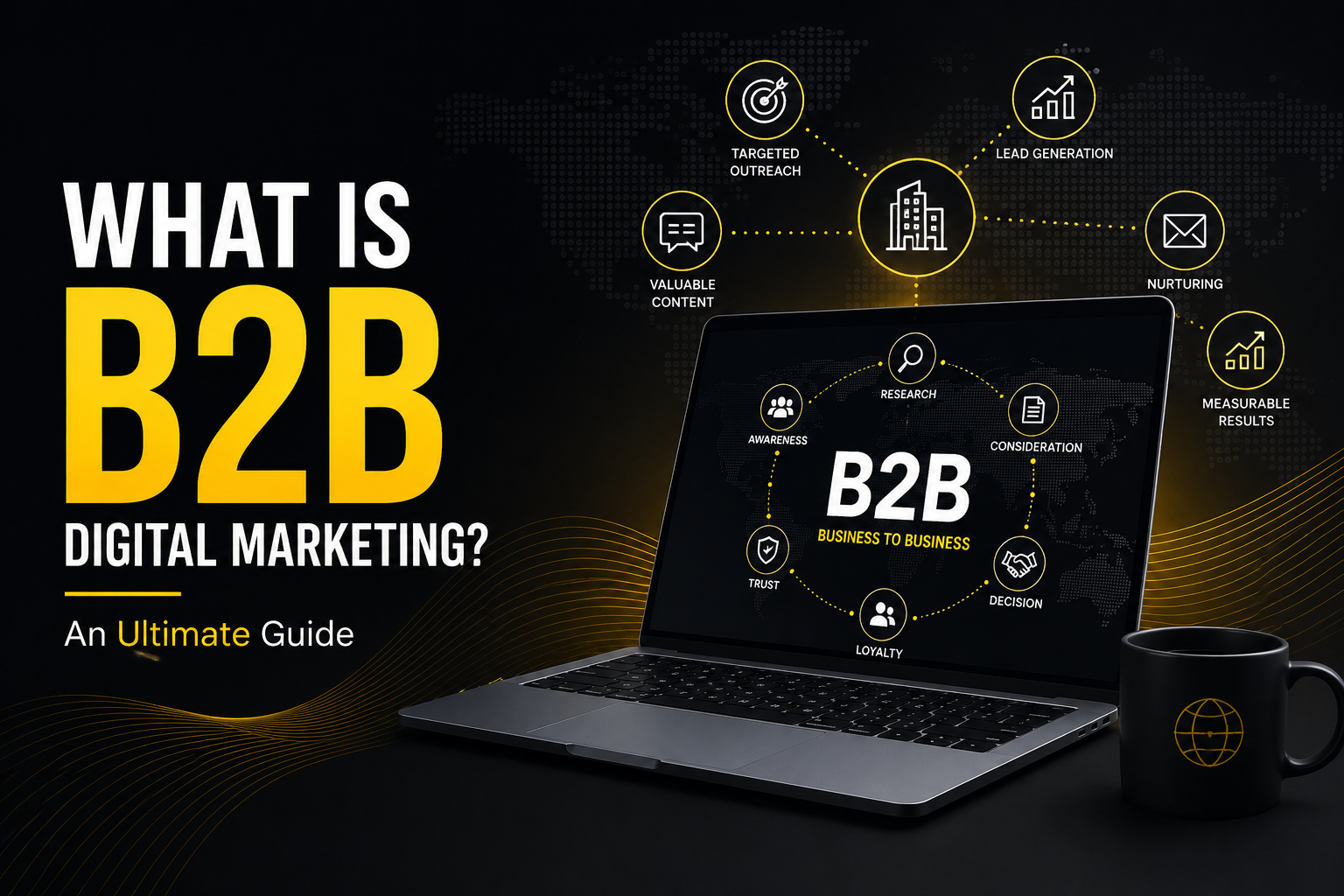
B2B (Business-to-Business) digital marketing is the process of promoting products or services to other businesses instead of individual consumers. While B2B buyers are still influenced by human emotions and preferences, B2B marketing places greater emphasis on solving business challenges, demonstrating value, reducing risk, and building organizational confidence. Since one buying decision can impact an entire organization and involve a significant budget, businesses need clear, transparent communication that demonstrates real return on investment (ROI).
Today’s B2B buyers no longer wait for a sales call. According to McKinsey & Company’s 2026 B2B Pulse Survey, buyers use an average of ten channels throughout the purchasing journey, moving between digital, remote and in-person interactions. They search on Google, browse social media, read industry content, compare solutions, and explore multiple touchpoints. A successful B2B digital marketing strategy ensures your business is visible wherever buyers are looking, providing helpful information at every stage and positioning your brand as a trusted partner not just another vendor.
Why Is B2B Marketing Important?
B2B marketing is important because it helps businesses connect with other businesses that need their products or services. Whether you offer payroll software, manufacturing equipment, or professional services, effective B2B marketing ensures the right decision-makers discover your solution and understand how it can improve their operations.
Think about it, every business depends on another business to succeed. A lawn care company relies on lawn mower manufacturers and fertilizer suppliers, while a software company depends on reaching organizations that need to streamline payroll or improve productivity. Without B2B marketing, these valuable business connections would be much harder to build.
As more companies research and purchase online, B2B marketing continues to grow rapidly. Global B2B digital ad spending is projected to increase from $38.67 billion in 2025 to $48.15 billion in 2026, representing 4.3% of the worldwide advertising market, according to eMarketer. While the U.S. and China account for the largest shares of B2B digital advertising, while India and Mexico are expected to see some of the fastest growth in the coming years.
How B2B Is Different from B2C
B2B and B2C marketing may share the same goal of winning customers but the way they do it is completely different. B2B (business-to-business) marketing focuses on helping companies make informed purchasing decisions, while B2C (business-to-consumer) marketing is designed to influence individual buyers through emotion and convenience.
Think about buying a pair of shoes online. You might decide within minutes based on style or price. Now compare that to a company investing in payroll software or manufacturing equipment. That decision often involves multiple stakeholders, budget approvals, legal reviews, and months of research. Because of this, B2B marketing is built on trust, expertise, and long-term value, whereas B2C marketing focuses on emotional appeal, brand experience, and quick purchasing decisions.
| Feature | B2B Marketing | B2C Marketing |
| Primary Audience | Professional buying groups and department heads | Individual consumers and households |
| Buying Motivation | Business value, efficiency, risk reduction, and long-term impact | Personal needs, preferences, convenience, and emotional appeal |
| Sales Cycle Length | Long (months to years) | Short (minutes to days) |
| Tone of Voice | Expert, authoritative, and educational | Relatable, entertaining, and urgent |
| Relationship Focus | Deep, long-term partnerships | Transactional purchases and brand loyalty |
B2B Digital Marketing Strategies
Every successful B2B marketing campaign starts with one question: How do your customers make buying decisions? Before choosing any marketing channel, you need to understand where buyers discover your business, how they perceive your brand, and what influences them to take action. Once you know their journey, you can build a strategy that reaches them at the right time with the right message.
SEO
SEO is often the first step in helping potential customers discover your business online. Search Engine Optimization (SEO) improves your website’s visibility by optimizing keywords, metadata, image alt text, site performance, and earning quality backlinks. Better rankings lead to more qualified traffic and potential business opportunities.
Email Marketing
Email marketing remains an important B2B digital marketing channel. It can help businesses nurture leads, share valuable content, stay connected with prospects, and guide potential customers through longer buying journeys. Strong subject lines, clear calls to action (CTAs), audience segmentation, and mobile-friendly design can improve engagement and conversions.
Content Marketing
Content Marketing builds trust by educating potential buyers before they make a purchasing decision. Blogs, eBooks, case studies, and videos answer common questions, demonstrate expertise, and help businesses connect with their ideal audience. Testing different content formats reveals what performs best.
Social Media Marketing
Social Media Marketing helps B2B businesses increase brand awareness, build credibility, and establish industry authority. Sharing valuable content and encouraging employee generated posts can significantly boost engagement, with employee driven content receiving more than eight times the engagement of standard brand content.
B2B Digital Marketing Trends to Watch in 2026
B2B marketing is constantly evolving as businesses invest more in data, technology, and measurable results. Today’s marketers focus on reaching the right decision-makers, maximizing ROI, and using AI to create more personalized experiences. Here are some of the biggest B2B marketing trends shaping the industry.
B2B Budgets Are Often Planned and Renewed Annually
Many companies operate separate B2B and B2C divisions, each with its own marketing budget. Medium-sized businesses ($50M+ annual revenue) and large enterprises ($1B+ annual revenue) are especially likely to have dedicated B2B advertising budgets managed by separate teams. Many organizations review and renew their B2B advertising budgets annually, with planning often taking place between December and January, although timing varies by industry and company size.
B2B Spending Focuses on ROI and Conversions
B2B advertising spend usually peaks twice a year during March and April and again in September and October. Marketing investments are guided by return on investment (ROI) and conversion rates, with lead generation, customer acquisition, and brand awareness remaining the top priorities. Email marketing, social media advertising, and paid media continue to be the most widely used B2B marketing channels.
AI-Driven Targeting and Personalization Lead 2026 Trends
AI-driven targeting and personalization are becoming major priorities for B2B marketers. AI-driven targeting and personalization are becoming major priorities for B2B marketers. According to Amazon Ads research, about one-quarter of B2B advertisers were already using AI-driven targeting and personalization, while six in ten planned to test or pilot these capabilities in 2026.
AI Search Is Changing How B2B Buyers Discover Vendors
B2B buyers are increasingly using generative AI alongside traditional search and other digital channels to research suppliers and evaluate solutions. McKinsey’s 2026 B2B Pulse Survey found that generative AI has entered the top five channels for supplier discovery and evaluation. As a result, businesses need content that is not only optimized for traditional search engines but also structured to provide clear, authoritative answers across AI-powered search experiences.
2 Best B2B Marketing Examples
The best B2B marketing strategies don’t just promote products, they solve business problems and reach the right decision-makers. Companies like Samsung and HP demonstrate how targeted digital campaigns can increase brand awareness, engage qualified audiences, and drive measurable business results.
Samsung Uses Video Marketing to Reach B2B Audiences
When Samsung launched its new range of business TVs in Italy, the company wanted to reach businesses such as restaurants, retail stores, schools, hospitals, and hotels. To achieve this, Samsung partnered with Amazon Ads to run a three-month B2B campaign using video ads, Amazon DSP, and Amazon Business placements, which target verified business buyers.
The campaign was supported with remarketing ads that directed engaged audiences to detailed product pages. The campaign achieved a high video completion rate and helped Samsung engage relevant business audiences across its target industries.
HP Educates Small and Medium-Sized Businesses About Laser Printers
To relaunch one of its laser printer lines in India, HP partnered with Amazon Ads to reach small and medium-sized businesses (SMBs) and micro, small, and medium enterprises (MSMEs). The campaign targeted businesses actively interested in printers and related products across Amazon and Amazon Business.
HP highlighted key product benefits, including innovative ink-tank laser technology and a self-reloadable toner system, while re-engaging audiences who had previously interacted with its ads. The campaign generated a 1.01% click-through rate (CTR) and a 2.1% product detail page view rate on Amazon. On Amazon Business, the campaign generated more than 1.7 million impressions in 14 days, with CTR and product detail page view rates trending above 1.67% and 2.5%, respectively. HP also reached approximately 20% of registered and verified business customers on Amazon Business.
How to Measure ROI and Pipeline Impact of B2B Digital Marketing
Measuring the ROI of B2B digital marketing means understanding how your marketing efforts contribute to revenue and business growth. Since B2B sales cycles often last a year or more, success can’t be measured by website traffic alone. Instead, businesses need to track how marketing influences qualified leads, sales opportunities, and pipeline performance. According to Salesforce’s State of Marketing report, 83% of marketers report having a clear view into their impact on the sales pipeline.
- Lead Quality: Measure how many marketing-qualified leads (MQLs) progress into real sales opportunities. High-quality leads indicate your marketing is attracting the right audience.
- Pipeline Velocity: Track how quickly a prospect moves from the first interaction to a closed deal. A faster sales pipeline often reflects more effective marketing and sales alignment.
- Customer Acquisition Cost (CAC): Calculate the total marketing investment required to acquire a new business customer. Lower CAC with consistent lead quality indicates a more efficient marketing strategy.
- Account Engagement Score: Use a B2B marketing automation platform to monitor how many stakeholders within a target company engage with your content, emails, or campaigns. Higher engagement often signals stronger buying intent.
- Handoff Success Rate: Measure the percentage of marketing-qualified leads successfully handed to the sales team that result in a productive sales meeting. This metric helps evaluate the quality of leads and the effectiveness of marketing-to-sales collaboration.
Grow Your B2B Business with Smarter Digital Marketing
Winning in today’s B2B market takes more than simply having a website or running a few ads. Modern buyers research across multiple digital channels before making a decision, and every interaction shapes their trust in your brand. A successful B2B digital marketing strategy combines SEO, content marketing, paid advertising, email marketing, social media, and AI search optimization to reach decision-makers at every stage of the buying journey.
With 83% of marketers now able to measure their impact on the sales pipeline and B2B digital ad spending projected to reach $48.15 billion in 2026, businesses are investing more than ever in digital growth. At Real Global Marketing, we help businesses across the United States build data-driven B2B digital marketing strategies that increase visibility, generate qualified leads, and turn opportunities into long-term revenue. Our proven client results and commitment to measurable success have established us as the best US digital marketing agency for businesses looking to accelerate growth through strategic digital marketing. Whether you’re targeting local businesses or enterprise clients, our team delivers results-driven digital marketing solutions designed to help your business grow with confidence.
FAQs
1. Why is the B2B buyer’s journey longer than a typical consumer purchase?
B2B purchases often involve higher financial investments, greater organizational risk, and multiple stakeholders. According to McKinsey & Company, buyers now use an average of ten channels throughout the purchasing journey, researching solutions and comparing vendors across digital, remote, and in-person interactions.
2. Which digital channels yield the highest ROI for B2B companies?
The most effective B2B marketing channels include Search Engine Optimization (SEO) for high-intent discovery, Content Marketing to establish authority, Email Marketing for lead nurturing, and Social Media Marketing to build brand awareness and credibility.
3. What role does employee-driven content play in B2B social media marketing?
According to LinkedIn data cited in recent industry research, content shared by employees can generate roughly eight times more engagement than content shared through brand channels.
4. How do B2B companies allocate and plan their marketing budgets?
Many B2B organizations review and renew their advertising budgets annually, with planning often taking place between December and January. However, timing varies by industry, company size, and business needs. B2B advertising spend can also peak during spring and fall, particularly around March–April and September–October.
5. How is AI changing B2B digital marketing trends?
AI is changing B2B digital marketing across targeting, personalization, content creation, buyer research, and search. AI-driven targeting and personalization are already being adopted by B2B advertisers, while generative AI is becoming an increasingly important channel for supplier discovery and evaluation. For marketers, this means creating useful, authoritative content that can serve buyers across both traditional search and AI-powered experiences.