Google sees more than 5 trillion searches every year. And search is no longer limited to traditional search engines, with AI-powered platforms changing how people discover information. Yet, 90.63% of pages in an Ahrefs study received no organic traffic from Google.
Why? Because most brands build a website and assume people will just find it.
SEO is the invisible engine that dictates who wins and who gets ignored. But if you’ve ever tried to research SEO, you’ve probably been hit with a wall of confusing terms, conflicting advice, and panic about AI taking over.
Let’s change that.
SEO isn’t rocket science, and AI isn’t here to break it, it’s here to supercharge it. In this guide, we’re cutting through the noise to break down the mechanics of modern search, step-by-step.
What Is Search Engine Optimization (SEO)?
Search Engine Optimization (SEO) is the process of improving a website so it ranks higher in search results earning free, organic traffic instead of paying for it. The higher your website ranks, the more people see it, click on it, and eventually become customers.
Here’s the simplest way to think about it: every time someone types a question into Google, thousands of websites are competing to be the answer. SEO is how you win that competition not by paying for a spot, but by proving to search engines that your page is the most relevant, trustworthy answer available.
That competition, though, isn’t just happening on Google anymore. Search has quietly split across platforms. Someone looking for a recipe might search YouTube instead of Google. Someone researching a product might check TikTok before checking a search engine at all. Each of these platforms has its own search and recommendation systems, which means SEO today means optimizing for wherever your audience is actually searching, not just Google.
Quick tip: SEO is no longer just about Google or Bing. Optimizing your presence on YouTube and TikTok is becoming just as important, since more people now use these platforms directly as search engines.
What Are the Three Pillars of SEO?
The three pillars of SEO are Technical SEO, On-Page SEO, and Off-Page SEO. Together, these three components help search engines understand, trust, and rank your website. A successful SEO strategy balances all three pillars to improve visibility, drive organic traffic, and create a better user experience.
Think of SEO like building a house.
You can have the most beautiful interior, but if the foundation is weak, the house won’t last. Likewise, even a technically perfect house won’t attract visitors if no one knows it exists. Every part needs to work together.
The same principle applies to search engine optimization. Your website needs a strong technical foundation, valuable content, and authority built through trusted sources. Let’s explore each pillar.
Technical SEO
Technical SEO focuses on optimizing the behind-the-scenes elements of your website so search engines can crawl, index, and understand your pages efficiently. While visitors may never notice these improvements, search engines certainly do.
Technical SEO includes tasks such as:
- Improving website speed and Core Web Vitals
- Creating and submitting XML sitemaps
- Fixing crawl errors and broken links
- Optimizing mobile responsiveness
- Using HTTPS for website security
- Implementing structured data (Schema Markup)
- Improving website architecture and internal linking
On-Page SEO
On-page SEO is everything you optimize on your website to make your content more relevant and valuable for both users and search engines.
It isn’t about stuffing keywords into every paragraph. Modern SEO focuses on understanding search intent and providing the best possible answer to a user’s question.
On-page optimization includes:
- Creating helpful, high-quality content
- Targeting relevant keywords naturally
- Optimizing title tags and meta descriptions
- Using clear heading structures (H1, H2, H3)
- Writing descriptive image alt text
- Improving readability and user experience
- Adding internal links to related pages
Off-Page SEO
Off-page SEO refers to all the activities that improve your website’s authority outside your own site. Backlinks remain an important signal of authority, particularly when they come from relevant, reputable websites.
Think of backlinks as recommendations. When respected websites link to your content, search engines view those links as signals that your website is credible and trustworthy.
Off-page SEO strategies include:
- Earning high-quality backlinks
- Digital PR and brand mentions
- Building local citations
- Managing online reviews
- Increasing brand authority across the web
Paid Search vs. Organic Search: The Differences and Similarities
Paid search and organic search differ in five key ways: position, time, cost, ROI, and share of traffic but they share the same foundation: both rely on keywords, landing pages, and users actively searching for answers. Understanding both is essential, since a strong SEO strategy rarely exists in isolation from paid search.
Think of it this way: if organic search is planting a tree, paid search is renting one. Paid search gets you visible almost instantly, but the moment you stop paying, that visibility disappears. Organic search takes far longer to grow, but once it takes root, it keeps producing value for years without ongoing spend.
What Are the Differences Between Paid and Organic Search?
Position: Paid search results appear at the very top of the search results page, marked as ads or sponsored posts. Organic results appear below them, earned purely through relevance and authority rather than payment. Search results themselves are becoming less predictable, since Google’s AI Overviews now reshape how paid and organic content is displayed making it more important than ever to stay current on how these placements shift.
Time: Paid search delivers results almost immediately, turns on a campaign, and traffic can start flowing within hours. Organic search plays a longer game. Rankings typically take weeks, months, or even years to build, since search engines need time to trust and index new content. If paid search is a sprint, organic search is a marathon.
Payment: Paid search works on a pay-per-click (PPC) model where you pay a fee every time someone clicks your ad, essentially buying visibility instead of earning it. Organic traffic, by contrast, is free to receive, though it still requires real investment in time, content, and optimization to earn that placement.
ROI: Paid search ROI is easier to measure in the short term, since platforms like Google Ads provide detailed performance data through tools like Google Analytics (GA4). But that ROI can plateau or decline once you stop investing. Organic search ROI is harder to measure precisely, but it tends to compound improving steadily over time and often delivering stronger long-term returns than paid campaigns alone.
Share of Traffic: Organic and paid search remain major sources of website traffic, but the way people interact with search results is changing. AI Overviews, AI Mode, featured results, local results, videos, and other SERP features can satisfy users without sending them to a website. That makes visibility increasingly important beyond the traditional organic blue links.
What Do Paid and Organic Search Have in Common?
Despite their differences, paid and organic search share the same core building blocks:
Keyword Research: Both rely on understanding what your audience is actually typing into the search bar. Whether you’re bidding on a keyword or optimizing content around it, the research process starts the same way.
Landing Pages: Both require a strong landing page to convert visitors once they arrive. For organic search, that page lives within your website’s natural structure. For paid search, you can reuse that same page or build a standalone one designed specifically for ad traffic.
Intent-Driven Traffic: Most importantly, both channels attract users with active intent. Someone searching whether they click a paid ad or an organic result is actively looking for an answer, a product, or a solution. That mindset makes both types of traffic far more valuable than passive browsing, since intent-driven visitors are already primed to take action.
How Do Search Engines Actually Work?
At a high level, Google Search involves three core stages: crawling, indexing, and ranking. Every time someone types a question into Google, that answer doesn’t appear by magic; it’s the result of a complex system working behind the scenes to find, evaluate, and sort billions of web pages in a fraction of a second.
At the center of that system are algorithms and computer programs designed to interpret what searchers actually want and match them with the most relevant results. These algorithms decide which pages deserve to rank for any given keyword, which is exactly why algorithm updates can shake up entire industries overnight. A single update can push a brand from page one to page five, which is why staying current on both search engine algorithms and social media algorithms matters just as much as writing good content in the first place.
Step 1: Search Engine Crawling
Before a page can rank, it has to be found. That’s the job of crawling search engines to send out automated programs, often nicknamed “spiders,” “robots,” or “Googlebots,” to discover new pages and revisit old ones to check for updates.
These crawlers don’t wander randomly. They follow links, one after another, the same way a person might click from one page to the next. If your blog is linked from your homepage, a crawler visiting your homepage will follow that link straight to your blog post, and from there, to whatever it links to next. This is why internal linking matters so much: pages with no links pointing to them are often invisible to search engines entirely.
Step 2: Search Engine Indexing
Once a page is discovered, the search engine has to decide whether it’s worth keeping. That decision is called indexing. If your content passes the test, it gets filed into a massive database, the index where it can be pulled up later when someone searches for something relevant.
Not every page makes the cut. A page may be left out of the index if it can’t be crawled properly, has technical indexing restrictions, contains duplicate or substantially similar content, or doesn’t meet Google’s quality and content requirements.
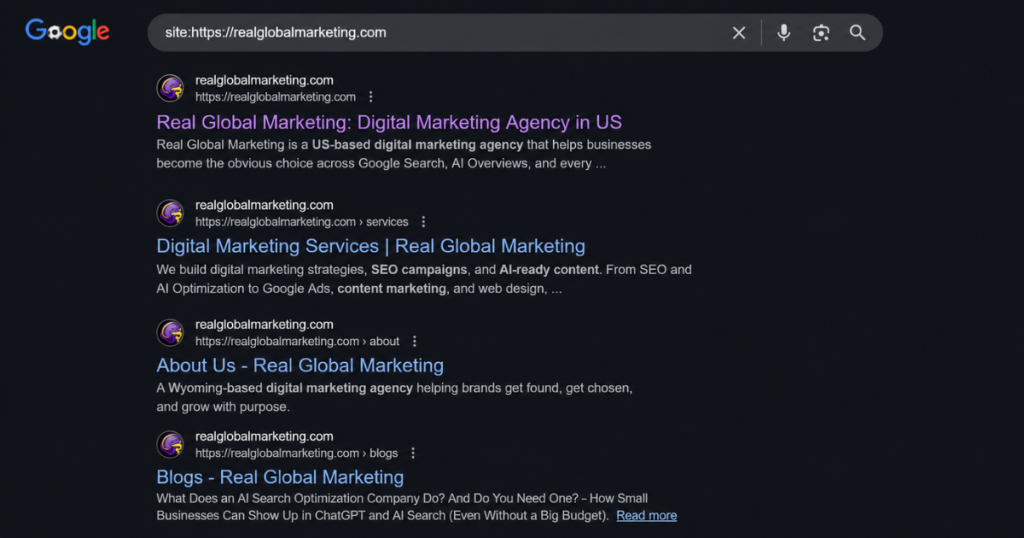
Quick tip: You can check which of your own pages are indexed by typing “site:yourdomain.com” into Google’s search bar. For a more detailed breakdown, Google Search Console’s Index Coverage report shows exactly what’s indexed, and what’s been left out, along with why.
Step 3: Search Engine Ranking
This is where everything comes together. Ranking can only happen after a page has been crawled and indexed, you can’t rank what search engines haven’t found and approved first.
Google uses many ranking systems and signals to determine which content is most relevant and useful for a given search. Factors and signals that can influence search visibility include:
- Relevance: how well the content matches what the searcher is looking for
- Content quality: whether the content is helpful, reliable, and created for people
- Page experience: factors such as Core Web Vitals, mobile usability, and HTTPS
- Links: links from other pages can help Google discover content and understand its relevance and importance
- Context: factors such as language, location, and the meaning behind the query
If you’re looking for agency support with SEO, AEO, content marketing, or paid ads, get in touch with Real Global Marketing, a full-service US digital marketing agency.
How Does Google Order and Rank Search Results?
Google ranks search results using a combination of algorithms including Hummingbird, Panda, and RankBrain that work together to understand what searchers actually want, not just which pages contain the right keywords. Think of these algorithms as different specialists on the same team: each one evaluates a different aspect of a page, and together they decide the final order you see on the results page.
RankBrain is Google’s machine-learning system that helps it understand how words and concepts relate to one another. This allows Google to return relevant results even when a page doesn’t contain the exact words used in a search.
For SEO, the practical takeaway is simple: don’t write content by mechanically repeating keywords. Focus on covering the topic clearly, understanding search intent, and creating content that genuinely helps the reader.
In other words, Google isn’t just asking “does this page contain the right words?” It’s asking “did this page actually give the searcher what they needed?”
Alongside these algorithms, Google also evaluates content through its E-E-A-T framework. E-E-A-T stands for Experience, Expertise, Authoritativeness, and Trustworthiness. Google uses these concepts in its Search Quality Rater Guidelines to help human evaluators assess the quality of search results. E-E-A-T itself is not a single ranking factor or score.
Quick tip: Google Search is increasingly incorporating generative AI through features such as AI Overviews and AI Mode. These experiences can synthesize information from multiple sources and let users explore topics conversationally, making it increasingly important to optimize for visibility beyond traditional blue-link rankings.
How to Optimize for Modern Search
The best approach to modern SEO is to stop optimizing purely for keywords and start optimizing for relevance, usefulness, and user experience. The strategies that help your content perform in search are often the same ones that make your site better for real people.
Here are the most effective ways to do that:
- Target long-tail and medium-tail keywords phrases and key terms made up of two to three words. These tend to match real search intent more precisely than single broad keywords, since they reflect how people actually search when they know what they want.
- Write in natural language. Content that reads the way people actually speak is easier for RankBrain to understand and rank, and it naturally reads better for humans too. Relevance and value matter more than rigid keyword placement.
- Optimize page titles and descriptions so your listing stands out and earns the click when it appears in search results. This directly impacts your click-through rate, the percentage of people who see your listing and choose to click through to your site.
- Improve the page experience. Make your content easy to scan, answer the searcher’s question quickly, provide useful supporting information, and give visitors clear next steps when appropriate.
- Boost engagement through richer content. Adding videos, breaking up text with images, or including expert quotes and practical tips can make your content more useful, engaging, and easier to consume.
What Is an SEO Strategy?
An SEO strategy is a structured plan for optimizing your content so it ranks as high as possible on search engines ideally landing on page one, position one. Without a strategy, SEO becomes guesswork publishing content and hoping something sticks, rather than building toward a clear goal.
Like every other part of digital marketing, SEO only works when it’s guided by a plan you can implement, track, and adjust over time. The goal of an SEO strategy is straightforward boost organic traffic so your target audience can actually find you when they search.
A clear strategy also protects your time and budget. Instead of pouring resources into content that never performs, a strategy keeps you focused on creating content built around real performance data and genuine user intent not guesswork or trends that fade.
Quick tip: If you run a small business or serve a specific geographic area, local SEO deserves a central place in your strategy. It’s one of the most effective ways to get found by the people most likely to become your customers, the ones searching right in your own backyard.
How to Set Objectives for Your SEO Strategy
Setting clear SEO objectives means defining specific, measurable goals that connect directly to your broader business objectives, not just chasing higher rankings for their own sake. Without that connection, SEO can feel like effort disconnected from outcomes, which makes it hard to justify the time and budget it takes to do well.
Clear objectives matter for a few key reasons:
- They make it easier to earn buy-in from key stakeholders, since everyone can see how SEO ties back to real business results.
- They give shape to your entire SEO strategy, turning vague ambitions into an actual roadmap.
- They keep your team accountable, ensuring goals actually get met rather than quietly slipping.
What Metrics Should You Measure for SEO?
The metrics worth tracking depend on where they sit in the funnel from initial visibility all the way down to actual revenue. Setting objectives is only half the equation; measuring them is what turns SEO from a guessing game into a system you can actually improve over time.
Here’s how the most important SEO metrics break down by funnel stage:
Top of Funnel (TOFU): Visibility Metrics
- Impressions: The number of times your website appears in search results. Impressions show how often Google is exposing your pages to potential searchers, even when they don’t click.
- Organic clicks: The number of clicks your website receives from unpaid search results. Tracking organic clicks over time helps you understand whether your search visibility is translating into actual visits.
- Click-through rate (CTR): The percentage of impressions that result in a click. A higher CTR can indicate that your search result’s title and description are compelling and relevant to the query.
- Average position: The average position of your website’s search results for the queries it appears for. Tracking this metric can help you identify whether your pages are gaining or losing visibility for important searches.
- Indexed pages: The number of pages from your website that Google has included in its search index. Monitoring indexation can help identify technical issues that prevent important pages from appearing in search results.
Middle of Funnel (MOFU): Engagement Metrics
- Time spent on page: how long visitors stay once they land. Longer time on page usually signals that people are finding real value in your content.
- Engagement rate: the percentage of sessions that meet Google’s definition of an engaged session in GA4. Use it alongside metrics such as organic clicks, conversions, and engagement time rather than treating it as a standalone measure of SEO success.
Bottom of Funnel (BOFU): Business Impact Metrics
- Conversions: The actions you want visitors to take after arriving through organic search, such as submitting a form, requesting a quote, signing up, or making a purchase. Tracking conversions connects SEO visibility to actual business outcomes.
- Organic revenue and leads: The revenue or qualified leads generated through organic search. These are among the most valuable SEO metrics because they connect search performance directly to business growth.
3 Examples of SEO Objectives
Strong SEO objectives are specific, measurable, and grounded in reality, not just ambitious numbers picked out of thin air. Where you set the bar depends heavily on where you’re starting from. If you’re just beginning to take SEO seriously, keep your targets modest but still meaningful. If you already have SEO traction and real data behind you, you can afford to be more aggressive as long as those targets are still grounded in what your existing performance actually supports. Unrealistic goals don’t inspire ambition; they just set you up for disappointment.
Here are three examples you can use as a starting point for your own objectives:
- Move 50% of our top 20 keywords onto the first page of Google within nine months.” This objective centers on keyword ranking, a clear trackable way to measure visibility improvement over time.
- Improve year-on-year organic traffic by 20% in Q3 and 25% in Q4.” This objective focuses on traffic growth, tying SEO performance directly to a measurable increase in visitors.
- Grow SEO market share from 3% to 5% in the next financial year.” This objective focuses on competitive positioning not just growing on your own, but growing relative to competitors in your space.
How to Set Objectives for Different Types of Businesses
The right SEO objectives depend on what kind of business you run transactional or informational since each one measures success differently. If:
- Your business is transactional and includes e-commerce – your objectives should center on sales and lead conversions the metrics closest to actual revenue.
- You run a non-ecommerce commercial site – lead generation becomes the more relevant focus instead, since conversions happen offline or through a separate sales process.
- Your business is informational a blog, publication, or resource-driven site – your objectives are more likely to focus on brand awareness and website traffic, since the goal is building an audience rather than closing a direct sale.
Remember, even with a fully implemented strategy, SEO is never truly “finished.” Search engines constantly evolve, competitors refine their strategies, and tactics that delivered results last year may need to be updated today. SEO isn’t a one-time project with a fixed end date; it’s an ongoing process that requires continuous optimization, patience, and strategic adjustments. With a strong foundation and consistent effort, however, the long-term rewards are substantial: improved user experience, higher search visibility, increased organic traffic, and more qualified conversions that help your business grow over time.
What Are the Best SEO Tools?
The best SEO tools depend on your specific need for ranking and reporting, technical audits, keyword research, or AI-driven insights and thankfully, there’s a strong tool for every stage of the process. Some come with generous free plans, others require a subscription, but the right combination can make the difference between guessing and actually knowing what’s working.
Here’s how the landscape breaks down by function:
Ranking and Reporting Tools
Google Search Console, GA4, KWFinder, and SemRush help you track how your site performs over time from keyword rankings to overall traffic trends. Page Speed Insights rounds this category out, giving a clear read on how fast your pages load, a factor that directly impacts both rankings and user experience.
SEO Audit Tools
Screaming Frog, SEOptimer, and Moz dig into the technical health of your site, surfacing issues like broken links, missing metadata, or crawl errors before they quietly hurt your rankings.
Keyword and Content Research Tools
Google Keyword Planner, AnswerThePublic, UberSuggest, and BuzzSumo help you understand what your audience is actually searching for, and what content is already resonating around those topics.
AI-Powered SEO Tools
Newer platforms like seoClarity and Surfer bring AI directly into the optimization process, helping teams move faster without sacrificing accuracy.
AI and SEO: What’s Coming Next?
Artificial intelligence isn’t a future trend in SEO, it’s already reshaping how search works today, from content generation to understanding user intent. The next phase of SEO won’t be about ignoring AI or working around it. It’ll be about knowing exactly where it fits into your strategy.
Here are the key developments worth watching:
- AI-powered search: Google Search now includes AI Overviews and AI Mode, which can generate synthesized responses and provide links to supporting sources. AI Overviews have expanded globally, changing how users discover information and interact with traditional search results.
- Predictive analytics. AI tools can analyze historical data and current trends to anticipate algorithm shifts before they fully roll out, giving proactive teams a head start on adapting their strategy.
- AI in local SEO. AI-driven tools can help tailor content based on regional preferences and local search behavior, strengthening visibility for location-specific searches.
- Answer Engine Optimization (AEO). As people increasingly use AI-powered search and answer engines to discover information, marketers are adapting SEO practices to improve the likelihood that their content is understood, surfaced, and cited in AI-generated answers.”
- Video SEO. With video consumption continuing to grow, optimizing content for platforms like YouTube is no longer optional for brands looking to stay visible.
- Core Web Vitals (CWV). These three user experience metrics measure how quickly a page loads, how responsive it is, and how visually stable it stays while loading. Optimizing these metrics can improve page experience and is one part of creating a technically sound website.
Grow Your Traffic and Brand Awareness With SEO
A strong SEO strategy does more than improve rankings; it puts your business in front of people actively searching for what you offer, driving both traffic and long-term brand recognition.
Every time someone searches for a product, service, or answer related to your business, SEO determines whether you show up or stay invisible. The more consistently you appear in those results, the more your brand becomes familiar, and familiarity builds trust long before someone even clicks.
Unlike paid ads, the traffic SEO generates keeps compounding over time. Content you publish today can continue driving visitors, leads, and brand exposure months or even years down the line, making SEO one of the most sustainable investments in your overall marketing strategy.
FAQs
What is SEO in simple terms?
SEO stands for Search Engine Optimization, the process of improving a website so it ranks higher in search results and earns free, organic traffic instead of paying for it.
Why is SEO important?
SEO helps your business get found by people actively searching for what you offer. Since organic search drives a large share of all website traffic, strong SEO means more visibility, more leads, and more customers without relying solely on paid ads.
What are the main ranking factors in SEO?
The main ranking factors fall under three pillars: technical optimization (site speed, mobile-friendliness, crawlability), on-page optimization (content quality, keyword relevance), and off-page optimization (backlinks and website reputation).
How long does SEO take to show results?
SEO strategies may take three to six months or more to show meaningful results, since search engines need time to crawl, index, and build trust in new or updated content.
How do I start doing SEO for my own website?
Start with keyword research to understand what your audience searches for, then optimize your site’s content, titles, and technical setup around those terms. From there, build quality backlinks and consistently publish valuable content to strengthen your rankings over time.