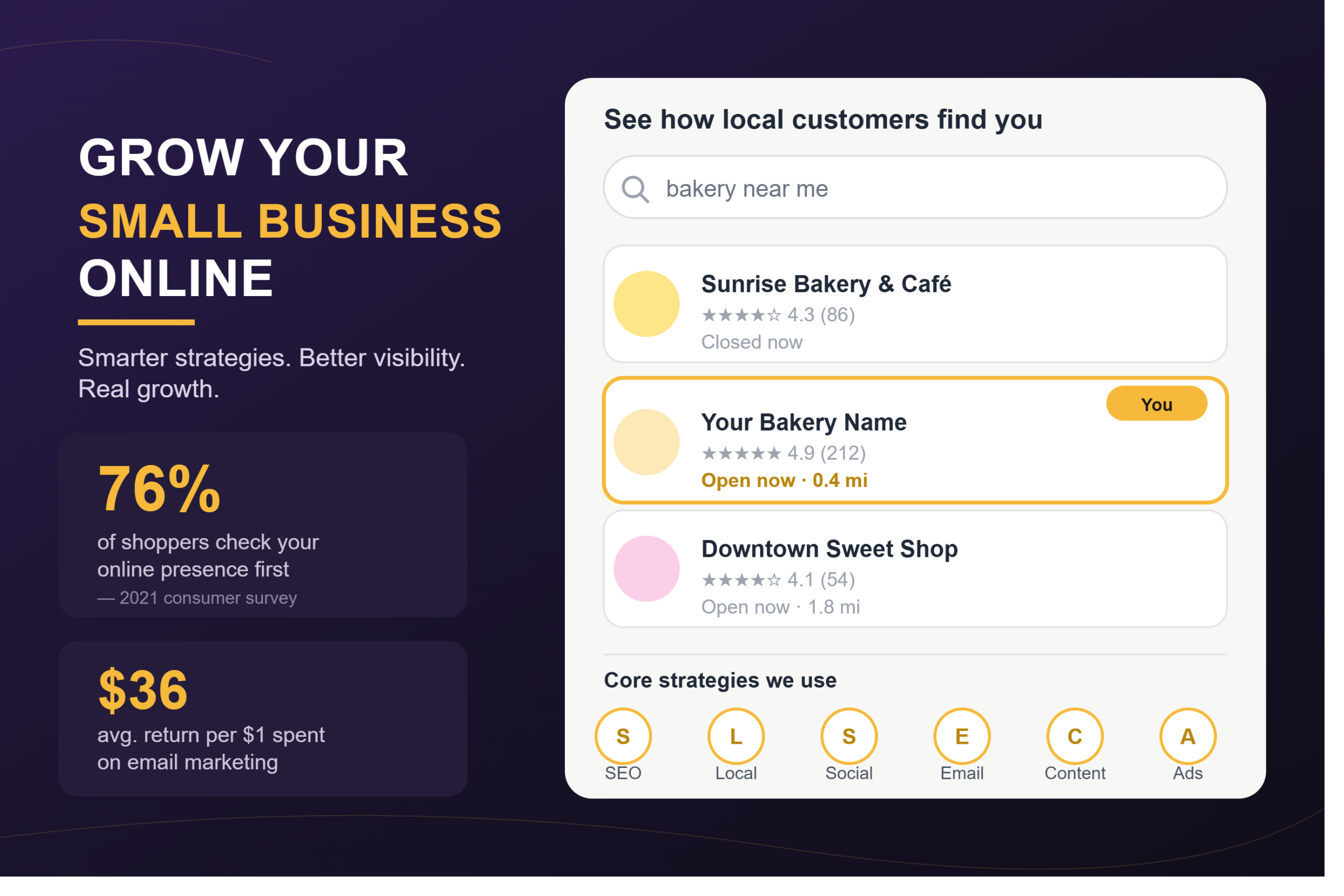
Running a small business has never been more competitive. Having a great product or service is no longer enough if your customers can’t find you online. Today, digital marketing for small businesses is one of the most effective ways to increase visibility, attract qualified customers, and grow consistently without the massive budgets once required for traditional advertising.
A 2021 study found that 76% of consumers look at a business’s online presence before visiting in person, while 45% said they were likely to visit a business after finding a strong online presence through local search.
Whether you’re launching a new business or looking to grow an established one, the right digital marketing strategy can help you generate leads, build trust, and turn online searches into paying customers. In this guide, you’ll discover why digital marketing is important for small businesses and learn practical strategies you can start using to grow your business.
What Is Digital Marketing for Small Businesses?
Digital marketing for small business is the process of promoting your products or services through online channels to attract customers, generate leads, and grow your business. It includes strategies such as search engine optimization (SEO), social media marketing, content marketing, email marketing, paid advertising, and local search optimization. Unlike traditional marketing, digital marketing can help small businesses compete for visibility and customers without matching the advertising budgets of larger companies.
Consider a local bakery that wants to increase walk-in customers and online orders. Instead of relying only on flyers or newspaper ads, it can use Google Business Profile, Instagram, Facebook, and local SEO to showcase fresh products, promote special offers, and appear when people search for terms like “bakery near me.” This targeted approach helps attract nearby customers who are already looking to buy.
The best digital marketing services for small businesses combine multiple strategies to build a strong online presence, increase website traffic, engage potential customers, and turn searches into sales. Whether you’re launching a startup or growing an established company, small business digital marketing helps you compete more effectively, maximize your marketing budget, and create sustainable long-term growth.
Why Is Digital Marketing Important for Small Businesses?
Digital marketing is important for small businesses because you can reach potential customers wherever they spend their time Google, social media, email, and other digital platforms. Every campaign is measurable, making it easier to understand what works and improve your results over time.
Some of the biggest benefits of digital marketing for small businesses include:
- Reach more customers: Expand beyond your local area and connect with potential customers anywhere, without geographic limitations.
- Target the right audience: Use customer data, interests, and location to reach people who are most likely to buy your products or services.
- Increase customer engagement: Build stronger relationships through social media, email marketing, and personalized communication.
- Generate more leads and sales: Guide potential customers through every stage of the buying journey with targeted digital campaigns.
- Lower marketing costs: Get better returns compared to many traditional advertising methods while staying within your budget.
- Track performance in real time: Monitor website traffic, leads, conversions, and campaign performance to make data-driven decisions.
- Improve customer experience: Respond quickly to inquiries, reviews, and messages while building trust and long-term customer loyalty.
How Can Small Businesses Use SEO to Grow Their Business?
Search Engine Optimization (SEO) is one of the most valuable small business digital marketing strategies because it helps your website appear when potential customers search for products or services you offer. Instead of paying for every click, SEO drives consistent organic traffic, builds trust, and generates qualified leads over the long term.
Imagine you own a local plumbing company. When someone searches “emergency plumber near me” or “best plumber in Chicago,” an SEO-optimized website has a much better chance of appearing in Google Search and Google Maps. Higher visibility in relevant search results can help your business attract more website visitors, phone calls, and inquiries.
A successful strategy starts with keyword research. Identify the search terms your customers use and naturally include them in page titles, headings, meta descriptions, URLs, and website content. Creating helpful service pages, blogs, FAQs, and location-based content also helps search engines understand your business while providing value to your audience.
Local SEO is equally important. Optimize your Google Business Profile with accurate contact details, business hours, service areas, high-quality photos, and regular updates. Encouraging genuine customers to leave honest reviews can strengthen your reputation and may help your local visibility.
Another essential part of SEO is building authority. Earning relevant, high-quality links from reputable websites can strengthen your site’s authority and contribute to its search visibility. Combined with a fast, mobile-friendly website and valuable content, digital marketing services for small businesses can help you attract more customers, reduce reliance on paid advertising, and achieve sustainable long-term growth.
How Does AI Search Affect Small Business Marketing?
Search is changing as customers increasingly use AI-powered search experiences to discover businesses, products, services, and answers. For small businesses, this makes it even more important to provide clear, useful, and trustworthy information across your website and other online profiles.
Google’s AI-powered search features build on many of the same fundamentals as traditional SEO. Small businesses should continue focusing on helpful, original content, clear service information, strong local signals, accurate business details, and a website that search engines can access and understand.
AI Search Optimization isn’t about using a secret tactic to guarantee that your business appears in an AI-generated answer. Instead, the goal is to make your business and its expertise easy for search systems to understand, evaluate, and reference.
For small businesses, that means:
- Create detailed service and product pages that answer real customer questions.
- Demonstrate first-hand experience, expertise, and trustworthiness.
- Keep your Google Business Profile and other business information accurate and consistent.
- Publish useful content that goes beyond generic information already available online.
- Make important business details easy to find, including services, locations, pricing where appropriate, and contact information.
Traditional SEO and AI Search Optimization should work together rather than being treated as completely separate strategies.
Can Small Businesses Succeed with Content Marketing?
Yes. Small businesses can thrive with content marketing, even without a huge budget or a large team. The key isn’t publishing more content, it’s creating valuable, relevant content that solves your customers’ problems and builds trust over time.
Whether it’s blog posts, videos, social media updates, podcasts, or infographics, digital marketing for small business gives you the opportunity to showcase your expertise, connect with your audience, and turn visitors into loyal customers. With the right strategy, small business digital marketing can compete with much larger brands.
Plan Your Content Strategy First
Every successful campaign starts with a plan. Before creating content, ask yourself:
- Who is your target audience?
- What problems or pain points do they have?
- What is your goal, more leads, higher sales, or stronger brand awareness?
Answering these questions helps your digital marketing for small business strategy stay focused and measurable.
Audit Your Existing Content
Before creating something new, review what you already have. A content audit helps you identify valuable assets, discover content gaps, and prioritize topics your audience actually wants. If your budget or time is limited, focus on evergreen content that continues driving traffic and leads for months or even years.
Publish Where Your Customers Spend Time
Creating great content isn’t enough if your audience never sees it. Choose the platforms where your customers are most active, whether that’s your blog, email newsletters, Facebook, Instagram, LinkedIn, or YouTube. Maintain a content calendar so your small business digital marketing stays consistent instead of posting randomly.
Track Performance and Improve
The best digital marketing services for small businesses rely on data, not guesswork. Monitor website traffic, engagement, and conversion rates to understand what works. Regular analysis allows you to improve your content strategy as customer behavior changes.
Promote Your Content Effectively
Once your content is published, maximize its reach with affordable promotional strategies:
- Share blog posts and videos on Facebook, Instagram, X, and LinkedIn using platform-specific formats, relevant topics, and engaging visuals.
- Send personalized email newsletters featuring new content, promotions, and product updates.
- Collaborate with influencers, publish guest posts, and participate in industry communities to expand your reach.
- Repurpose existing content into videos, infographics, podcasts, or social media posts to extend its value across multiple channels.
How Can Small Businesses Use Social Media Marketing?
Small businesses can use social media marketing by focusing on the platforms where their target customers are most active, creating valuable content consistently, engaging with followers, and tracking performance to improve results over time. A well-planned digital marketing for small business strategy helps increase brand awareness, build trust, generate qualified leads, and grow sales without requiring a massive marketing budget.
Go Where Your Customers Are
One of the smartest ways to succeed with small business digital marketing is to meet customers where they already spend their time. Instead of trying to maintain a presence on every social media platform, identify the two or three channels where your target audience is most active and focus your efforts there.
For example, a clothing boutique, restaurant, or beauty brand may benefit from visually focused platforms such as Instagram, while a consulting agency, accounting firm, or professional services business may find LinkedIn more valuable for sharing industry insights, building credibility, networking, and establishing thought leadership. The right platform depends on your audience, business goals, content strengths, and ability to stay consistent.
Learn More About Your Customers
Successful digital marketing for small businesses starts with understanding your audience. One advantage small businesses have over larger companies is being closer to their customers, making it easier to understand their needs, preferences, and buying behavior.
Study important details such as age, location, interests, and online habits before creating content. If your budget allows, conduct market research, analyze your competitors’ social media strategies, and test different platforms to see which ones generate the highest engagement, website traffic, and conversions. The more you know about your audience, the more effective your marketing becomes.
Develop a Content Calendar
Consistency is more valuable than posting every day without a plan. Creating a content calendar helps maintain a steady flow of engaging content while saving time and resources.
Include a healthy mix of product or service updates, behind-the-scenes content, customer testimonials, educational tips, industry news, and original insights. You can also showcase employee stories, celebrate customer success, or offer exclusive product previews to make your brand feel more personal. Using relevant topics, tagging complementary businesses, and participating in industry conversations can further expand your reach and attract new followers organically.
Listen, Engage, and Build Relationships
Social media is designed for conversations, not one-way promotion. Responding to comments, messages, and mentions shows customers that you value their opinions and builds lasting trust. Always communicate with a friendly, professional, and respectful tone, especially when addressing complaints or negative feedback.
Encourage user-generated content by running contests, giveaways, branded hashtag campaigns, customer spotlights, polls, quizzes, and surveys. Interactive content increases engagement, strengthens your online community, and provides valuable insights into customer preferences while encouraging more people to connect with your brand.
Measure Performance and Improve Continuously
The most successful small business digital marketing strategies are driven by data, not guesswork. Monitor important metrics such as reach, engagement, website traffic, click-through rates, leads, and conversions to understand what is delivering results and where improvements are needed.
Social media is competitive, and small businesses often have limited resources. By focusing on efficiency, consistency, meaningful engagement, and continuous optimization, your digital marketing for small business strategy can deliver long-term growth, stronger customer relationships, and a competitive advantage.
How Should a Small Business Approach Email Marketing?
A small business should approach email marketing by building a quality list, segmenting and automating outreach, designing emails that catch attention, and consistently tracking performance. Done right, email remains one of the highest-return channels available. Litmus has reported an average email marketing ROI of $36 for every $1 spent.
Phase 1: Develop Your Email List
Your email list is the foundation everything else is built on. Grow it by giving people a real reason to sign up, exclusive discounts, free resources, or genuinely useful content. Add sign up forms across your website, social profiles, and checkout process, so you’re capturing leads at multiple touchpoints instead of just one.
Phase 2: Delegate and Automate
Once your list is growing, someone needs to own the content, for many small businesses, that’s a single person wearing multiple hats. That makes list segmentation even more important: sorting subscribers by demographics, interests, or purchase history so every email feels relevant. Automation tools become essential here, streamlining targeted campaigns based on subscriber behavior without manual, one-by-one sending.
Phase 3: Catch the Reader’s Eye
Keep emails visually clean, mobile-responsive and easy to scan. Write clear, relevant subject lines that encourage subscribers to open the email, and include a clear call-to-action so they know exactly what to do next.
Consistency matters just as much as design, a predictable weekly newsletter or monthly promotion signals respect for the subscriber’s inbox, and for small businesses, that consistency is a real opportunity to build genuine connection.
Phase 4: Stay on Top of Performance Metrics
Monitoring open rates, click-through rates, and conversion rates costs nothing but time, and it pays off. A/B testing subject lines, content, and send times turns guesswork into data-driven optimization.
To be truly effective, small business email campaigns need to address a few specific challenges and opportunities:
- Personalization on a budget: You don’t need expensive personalization software to make emails feel individual. Use the data collected at sign-up to address subscribers by name, and segment your list based on demographics, preferences, or past behavior, all without a large software investment.
- Local relevance: Small businesses often serve local or niche markets, so weaving in local references or community-centered content helps campaigns resonate. Highlighting local events, partnerships with nearby businesses, or customer stories from the community builds a sense of belonging and strengthens the connection between the business and its audience.
- Value propositions and offers: With a smaller reach and tighter budget, your incentive for subscribing needs to be clear and consistent from the very first email, whether that’s an exclusive discount, early access to new products, or content that solves a real problem.
- Resourceful design and content: Being small doesn’t mean looking unprofessional. Plenty of user-friendly email platforms offer customizable templates that require little to no design skill. Focus on writing content that’s concise, engaging, and clearly communicates your brand’s message, without overwhelming subscribers with unnecessary information.
How Do You Measure the Success of Your Small Business Digital Marketing Campaign?
You measure small business digital marketing success by tracking four core metrics: website traffic, conversions, engagement, and return on investment (ROI). Large enterprises may have entire teams dedicated to this, but small businesses can get just as much clarity by staying resourceful and focused on the numbers that actually matter.
Website Traffic
Monitoring how many visitors land on your website, and where they’re coming from, whether organic search, social media, or referrals shows you which digital marketing channels are actually driving people to your site.
Conversions
Tracking the percentage of visitors who complete a desired action, making a purchase, signing up for a newsletter, and filling out a form reveals how effectively your campaigns turn traffic into leads or sales.
Engagement Metrics
Likes, comments, shares, and click-through rates on social and email campaigns tell you how your audience is actually responding to your content, not just how many people saw it.
Return on Investment (ROI)
Comparing what you spend on marketing to the revenue it generates gives you a clear, honest picture of whether your campaigns are actually paying off.
Google Analytics remains one of the most valuable tools here and is free to use. Once installed on your website, Google Analytics 4 can help you understand where your traffic comes from, how users interact with your website, and which important actions they complete.
Keep your reporting focused on the metrics that matter most to your business, such as organic clicks, website traffic, leads, conversions, cost per lead, and revenue. For email campaigns, track metrics such as click-through and conversion rates. Adding UTM tracking codes to campaign links can provide additional insight, while platforms such as Meta Ads Manager and LinkedIn Analytics offer built-in reporting for campaign and audience performance.
Suppose a small online boutique is launching a campaign for a new handmade jewelry collection. Using Google Analytics, the owner tracks how many visitors land on the site and which channels social media, email, or paid ads are driving the most traffic. From there, they set up conversion tracking to see how many of those visitors actually make a purchase or add items to their cart.
For example:
- High traffic + low conversions = investigate the landing page, offer or checkout experience.
- Low traffic + high conversion rate = investigate visibility and acquisition.
- High traffic + high conversions = identify opportunities to scale.
What Opportunities Small Businesses Have?
Digital marketing gives small businesses an opportunity that wasn’t possible a decade ago. Instead of relying solely on word-of-mouth or expensive traditional advertising, you can reach the right customers through Google Search, social media, email, and other digital channels without needing a massive marketing budget.
As your business grows, your marketing should grow with it. What starts with a simple website and social media presence can evolve into advanced tools like CRM software, marketing automation, and analytics that help you better understand your customers and make smarter business decisions.
With consistent effort, valuable content, and the right marketing approach, even a local business can compete with larger brands, build lasting customer relationships, and achieve sustainable growth. That’s why investing in digital marketing services for small business isn’t just about getting more visibility, it’s about creating long-term success in an increasingly competitive marketplace.
What Should Your Small Business Focus on First?
Need local customers?
→ Google Business Profile + Local SEO
Need website traffic?
→ SEO + Content
Need leads quickly?
→ Google Ads / Meta Ads
Need repeat customers?
→ Email marketing
Need stronger brand awareness?
→ Social media + Content
Website isn’t converting?
→ Web design + Conversion Optimization
Don’t know what to prioritize?
→ Start with a digital marketing audit.
Start Growing Your Small Business Today with Digital Marketing
Growing a small business doesn’t require the biggest marketing budget, it requires the right strategy. At Real Global Marketing, we help small businesses build the digital visibility they need to attract customers and grow. Our team brings together SEO, local search, AI Search Optimization, content, paid advertising, web design and more with a strategy built around your business, not a one-size-fits-all package.
Whether you’re just getting started or looking to scale, our customized digital marketing services for small businesses are designed to deliver measurable results without wasting your budget. If you’re ready to build a stronger online presence and turn more searches into sales, partner with Real Global Marketing and grow your business with confidence.
FAQs
What is small business digital marketing?
Small business digital marketing is the process of promoting a business online using channels such as SEO, social media, email marketing, content marketing, paid advertising, and Google Business Profile. It helps small businesses increase visibility, attract qualified customers, generate leads, and grow revenue while staying within a manageable marketing budget.
How does digital marketing work for small businesses?
Digital marketing works by helping small businesses connect with customers where they already spend time online. Through strategies like local SEO, content marketing, social media, email campaigns, and paid ads, businesses can attract visitors, nurture leads, build trust, and convert online searches into paying customers while tracking every campaign’s performance.
What are the most effective digital marketing channels for SMBs?
The best channels depend on your business goals and audience, but the most effective options include Search Engine Optimization (SEO) for long-term organic traffic, Google Business Profile for local visibility, content marketing for building authority, email marketing for customer retention, social media marketing for engagement, and Google Ads or Meta Ads for generating immediate leads.
What are common digital marketing challenges for small businesses?
Small businesses often face challenges such as limited marketing budgets, lack of time, increasing competition, changing search algorithms, and measuring campaign performance. Creating consistent content, maintaining an active online presence, and choosing the right marketing channels can also be difficult without a clear strategy.
How much do digital marketing services cost for small businesses?
The cost of digital marketing services for small businesses varies depending on your goals, industry, and the services you need. Real Global Marketing offers affordable monthly packages starting around $299, while more comprehensive strategies that include SEO, paid advertising, content marketing, and web development may require a larger investment. The right plan should align with your budget while delivering measurable business growth.