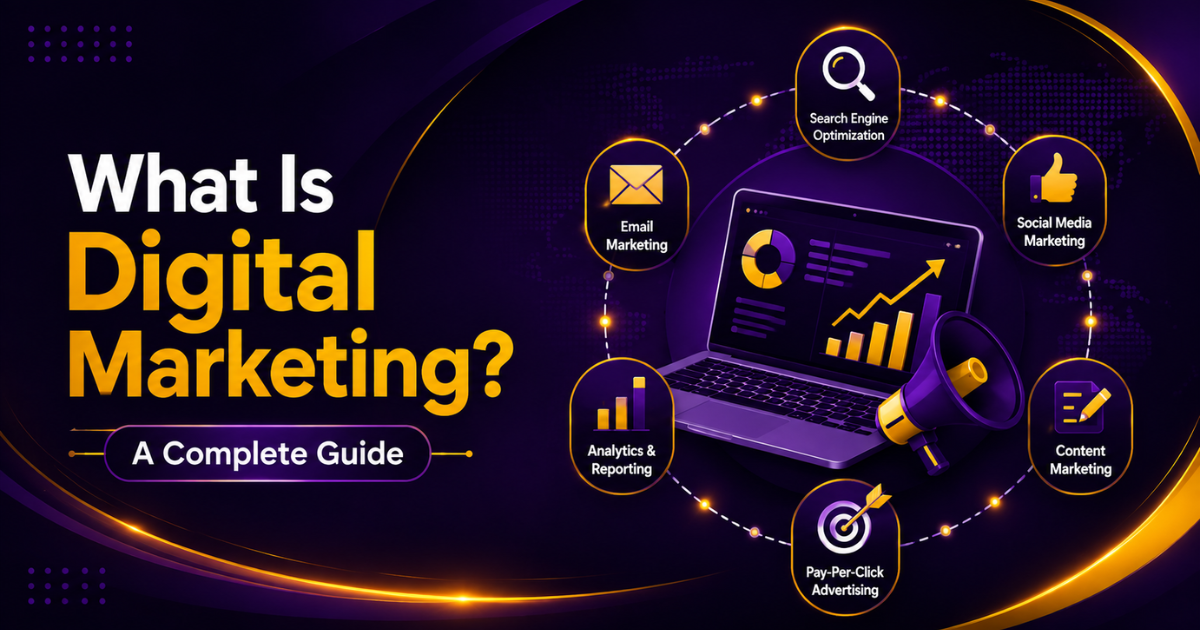
Digital marketing is the practice of promoting products or services through internet based channels including websites, search engines, social media, email, and mobile apps to build brand awareness, attract customers, and drive measurable business growth.
Every business today, from a two-person startup to a global enterprise, needs a way to reach people where they already spend their time: online. Digital marketing provides the tools to do exactly that, connecting with the right audience, building a recognizable brand, and generating growth in a crowded marketplace.
This guide covers the fundamentals of digital marketing: what it is, the channels and formats it includes, its benefits and challenges, and a practical framework for building a strategy around it.
What Is Digital Marketing?
Digital marketing is any marketing activity carried out through digital channels, with the goal of building brand awareness, driving traffic, and meeting specific business objectives. It connects brands with potential customers over the internet through formats such as:
- Search engines
- Websites
- Social media
- Mobile apps
- Text messaging
- Online advertising
The underlying principles are the same ones that guide traditional offline marketing, understanding an audience and delivering relevant messaging. What differs is the medium: digital marketing relies heavily on consumer data to identify who a business should target and how to reach them effectively.
How a company approaches digital marketing usually depends on its business model. Business-to-business (B2B) companies sell to other organizations, which typically means a longer, more strategic sales process. Business-to-consumer (B2C) companies sell directly to individual buyers, which usually means shorter sales cycles and a larger, more varied audience.
The right mix of digital tactics depends heavily on your business model. Companies selling to other businesses (B2B) typically face longer, more considered buying journeys that call for a relationship-driven approach. Companies selling directly to consumers (B2C) usually deal with shorter purchase cycles and a much broader pool of potential buyers.
Difference Between B2B and B2C Digital Marketing
| Factor | B2B Digital Marketing | B2C Digital Marketing |
| Decision makers | Multiple stakeholders are typically involved | Usually a single individual decides |
| Sales cycle | Longer and more deliberate | Shorter and faster to close |
| Messaging focus | Relationship-focused, educational | Urgent, benefit-driven |
| Primary decision driver | Logic and ROI | Emotion and desire |
Despite these differences, digital marketing works for both models. Whether the audience is a procurement team or an individual shopper, the same core channels can be adapted to fit the buying process.
What Are the Types of Digital Marketing?
Digital marketing includes many formats, generally grouped into owned, paid, and earned media, along with several channels that span all three categories.
Owned Media
1. Content Marketing
Content marketing is the practice of creating and sharing valuable, non-promotional content to educate an audience and build trust in a brand. Rather than pushing a direct sale, it positions a business as a credible, knowledgeable resource.
Businesses use content marketing to attract prospective customers and gradually turn them into loyal buyers. Common formats include:
- Blog posts
- eBooks
- Newsletters
- Guides
- Infographics
- Podcasts and other audio content
- Short-form and long-form video
It’s a cost-effective channel with strong long-term returns, which is a large part of why the content marketing industry continues to expand year over year.
2. Email Marketing
Email marketing is a form of direct marketing that reaches customers through targeted email campaigns, such as newsletters, welcome sequences, blog updates, and post-purchase follow-ups.
A few practices that improve email marketing performance:
- Personalize the subject line and body with the recipient’s name at minimum.
- Give each email a single, clear call to action.
- Always include an unsubscribe link.
- Balance transactional emails (like receipts) with promotional content.
3. Search Engine Optimization (SEO)
SEO is the process of optimizing a website’s content and technical structure so its pages rank higher in search engine results for relevant keywords. It generally breaks down into three areas:
- On-page SEO optimizes web copy around the keywords your audience searches for.
- Off-page SEO builds external credibility, primarily through quality backlinks.
- Technical SEO improves the site’s backend performance, including page speed, image compression, and metadata.
Paid Media
4. Search Engine Marketing (SEM) / PPC Advertising
SEM refers to paid ads that appear in search engine results pages (SERPs) when a user searches a relevant term. Advertisers pay each time someone clicks the ad. Google Ads and Microsoft Ads are the two leading SEM platforms.
SEM is effective largely because most online journeys begin with a search placing a brand at that starting point puts it in front of highly intent-driven users.
5. Affiliate Marketing
Affiliate marketing is a performance-based strategy in which affiliates promote a business’s products to their own audience in exchange for a commission or flat fee on resulting sales.
Because an affiliate’s audience already trusts their recommendations, that trust extends to the brand being promoted. Affiliates might publish reviews, unboxing videos, or simply link to a product within their content.
6. Pay-Per-Click (PPC)
Pay-per-click advertising charges an advertiser each time a user clicks their ad. Google Ads is the most widely used PPC platform for search, while Microsoft Ads, Meta Ads, YouTube Ads, and Amazon Ads serve other parts of the funnel.
To get more value from PPC spend:
- Improve ad relevance and Quality Score.
- Write an ad copy that speaks directly to the audience’s pain points.
- Optimize landing pages to match the ad’s promise.
Without a clear strategy, PPC costs can escalate quickly, so understanding the bidding dynamics of your chosen platform matters.
Earned Media
7. Social Media Marketing
Social media marketing promotes a business organically across platforms like Facebook, Instagram, YouTube, TikTok, and X, giving brands a direct, conversational connection with their most engaged followers.
To grow reach on social media:
- Understand which platforms your audience actually uses.
- Prioritize high-quality, engaging content over volume.
- Respond to comments and messages within 24 hours where possible.
- Post on a consistent schedule.
Higher engagement tends to translate directly into greater organic reach.
8. Influencer Marketing
Influencer marketing involves partnering with established content creators to promote a product or service to their audience. It’s similar to affiliate marketing in that it borrows an existing audience’s trust, but influencers are typically paid a flat fee rather than a commission.
Engagement rates on platforms like TikTok can run notably high, which is one reason more brands are investing in influencer partnerships.
To get the most from an influencer partnership:
- Choose influencers whose niche and reputation align with your brand.
- Put compensation and deliverables in a clear written agreement.
- Provide explicit guidance on tone, messaging, and disclosure requirements.
9. Native Advertising
Native advertising creates ads designed to match the look and feel of the platform they appear on, so they read more like organic content than a traditional ad.
This approach exists because audiences tend to tune out anything that looks overtly promotional. Even so, native ads should be clearly labeled “sponsored” or “promoted” to maintain transparency with the audience.
Other Digital Marketing Channels
10. Marketing Automation
Marketing automation uses software, AI, and machine learning to handle repetitive marketing tasks, freeing marketers to focus on strategy and creative work. Common applications include:
- Streamlining recurring workflows
- Tracking campaign performance
- Calculating campaign ROI
Automation also makes it possible to analyze large volumes of customer data quickly, supporting more personalized campaigns at scale.
11. Mobile Marketing / Text Messaging
Mobile marketing engages audiences directly on smartphones, tablets, and wearable devices, often through SMS messaging. Because most people keep their phones nearby throughout the day, mobile marketing allows for timely, direct communication similar to email in offering a personal, one-to-one channel.
12. Video Marketing
Video marketing promotes a business through long-form or short-form video content, most commonly on YouTube, TikTok, and Instagram.
It’s worth noting that YouTube functions more like a search engine than a traditional social network, which affects how content should be optimized for it. A smartphone alone is often enough to produce usable video for a website, social channels, email campaigns, and paid ads.
How Does Digital Marketing Work?
Digital marketing works by engaging audiences at multiple points along their journey with a brand from initial discovery through a search result or social post, to deeper engagement with content, to eventual conversion into a customer. Each channel plays a distinct role in that journey, and when channels are coordinated, their combined effect builds awareness, trust, and sales more efficiently than any single channel alone.
Is Digital Marketing the Same as Online Marketing?
No, the two terms are often used interchangeably, but online marketing is technically a subset of the broader category of digital marketing.
Digital Marketing
As the umbrella term, digital marketing includes any channel delivered through a digital device, including television, radio, and digital billboards, in addition to anything requiring a phone, tablet, or computer connected to the internet.
Online or Internet Marketing
This narrower term refers specifically to internet-based tactics, such as email, social media, SEO, and PPC. “Online marketing” and “internet marketing” are used interchangeably.
What Are the Benefits of Digital Marketing?
Whether a business operates B2B or B2C, digital marketing services help teams understand their audience, address pain points directly, and back decisions with measurable data. Key benefits include:
Reach a Large Demographic
Digital campaigns aren’t limited by geography. An online ad can reach audiences across countries and time zones without the added cost of traditional media buys.
Cost Efficiency
Digital channels are typically more affordable than traditional media like TV, radio, and print. Organic tactics such as social posting and blogging cost little beyond the time invested in creating them.
Results Are Measurable
Digital marketing offers analytics that traditional channels can’t match conversions, leads, site visits, and more, all trackable in real time.
Easier Personalization for Customers
The data generated through digital campaigns gives businesses deep insight into their customers, making it possible to segment audiences and tailor messaging to each group.
Opportunity to Engage Customers at Various Stages
Digital channels allow brands to stay connected throughout the buying journey, from an initial ad to a post-purchase follow-up, whether that’s a simple thank-you or an upsell opportunity.
Easy and Convenient Conversions
Cross-channel connectivity makes conversions fast; a shopper can move from a social media post to checkout on an ecommerce store in just a few taps.
Aligns Digital Marketing Efforts with Business Goals
A well-structured digital strategy ties directly to broader business goals, such as revenue growth, brand visibility, and customer retention, giving teams shared metrics to track progress against those goals.
How to Do Digital Marketing
This six-step framework offers a practical starting point for any industry or business model.
1. Define Your Goals
Start with goals that are specific, measurable, and aligned with your company’s broader objectives. Back each goal with concrete metrics so you can tell whether campaigns are performing or need adjustment. Metrics worth tracking include:
- Impressions
- Reach
- Clicks
- Click-through rate (CTR)
- Engagement rate
- Conversions
- Cost per lead (CPL)
- Effective cost per thousand impressions (eCPM)
2. Identify Your Target Audience
Define exactly who your campaigns need to reach. Audience behavior varies by channel, so it’s worth understanding how your followers engage on each platform rather than treating them as one uniform group.
3. Set a Budget for Each Digital Channel
A defined budget ensures resources are allocated sensibly, especially when balancing paid and organic efforts. Goals, target metrics, and existing costs should all inform how spending is split. If your budget fluctuates, consider allocating by percentage rather than a fixed dollar amount.
4. Select Your Digital Marketing Channels
With a budget in place, decide where to focus. Paid tactics like PPC can produce fast results, while organic approaches like SEO build value over time the goal is a balance between the two. Choose channels based on where your audience actually spends time; a campaign targeting Gen Z college students, for example, likely belongs on TikTok rather than Facebook.
5. Optimize Your Digital Assets for Mobile
Mobile traffic continues to grow, so marketing content should perform well on smartphones, even if it was originally designed for desktop. A seamless experience across devices helps prevent users from dropping off mid-journey.
6. Refine Your Marketing Efforts
Digital marketing is an ongoing process rather than a one-time project. Regularly reviewing social metrics, email performance, and site analytics keeps a strategy aligned with shifting consumer behavior and platform trends.
7. Create Cohesive Campaigns Across Multiple Channels
Individual channels tend to perform better together than in isolation. Even when a core audience is concentrated on one platform, tracking data across channels in a central system supports a more connected, effective campaign.
What Are the Challenges in Digital Marketing?
Digital marketing offers significant upside, but it also comes with recurring obstacles:
- Changing algorithms: Search engines and social platforms regularly update how content is ranked and displayed, which can affect SEO performance, paid campaigns, and overall visibility.
- Data privacy and compliance: Regulations like GDPR and CCPA require businesses to handle customer data carefully and transparently.
- Competition: Low barriers to entry mean digital channels can get crowded quickly, making it harder to stand out.
- Measuring ROI: Even with strong analytics, tying specific campaigns directly to revenue can be difficult, particularly for long-term strategies like SEO and content marketing.
- Customer trust: With so much content competing for attention, earning trust requires consistent value and authenticity rather than one-off campaigns.
Understanding these challenges in advance makes it easier for businesses to plan around them and adjust proactively.
What Are the Digital Marketing Trends for the Future?
1. Agentic AI and predictive personalization
AI is moving beyond simple content generation into autonomous agents capable of managing, optimizing, and executing entire campaigns in real time. This enables hyper-personalized recommendations and messaging at a scale manual processes can’t match.
2. Conversational SEO and answer-first content
As AI-powered search tools such as ChatGPT, Gemini, and Perplexity grow in use, people increasingly ask direct, conversational questions instead of typing keywords. This shift is pushing marketers toward Generative Engine Optimization (GEO): structuring content with clear schema markup and direct answers so AI tools can surface and cite it.
3. Search-social convergence and immersive technology
Social platforms are increasingly functioning as search engines and shopping destinations. Short-form video drives discovery, augmented reality lets shoppers preview products virtually, and communities increasingly favor authentic, user-generated content over polished corporate ads.
4. Privacy-first data and sharper revenue reporting
As third-party cookies phase out and privacy regulations like GDPR tighten, brands are shifting toward first-party and zero-party data collection, often exchanging value, like exclusive content, for information, and moving toward more holistic measurement models rather than relying solely on click-based metrics.
5. Trust as a competitive advantage.
As AI-generated content makes misinformation more common, audiences are placing greater value on authenticity. Brands that lead with transparency, ethical AI use, and genuine expertise are better positioned to build lasting customer loyalty.
Let’s Build Your Digital Marketing Strategy Together
Digital marketing rewards businesses that stay adaptable, data-driven, and audience-focused. Whether you’re building a strategy from scratch or refining an existing one, the channels and framework above provide a strong foundation for sustainable growth. If you’re looking for a trusted digital marketing agency in US, Real Global Marketing helps businesses build measurable strategies that increase visibility, attract qualified customers, and drive long-term results across search, AI, content, paid media, and web.
FAQs
SEO (search engine optimization) is the process of improving a website’s content and technical structure so it ranks higher in search results for relevant keywords, which increases organic traffic without paid advertising.
Effective digital marketers typically combine analytical skills, such as data interpretation and reporting, with creative skills like content creation and copywriting, along with working knowledge of SEO, paid advertising, email platforms, and social media tools.
Digital marketing costs vary widely based on channel mix, business size, and goals ranging from a few hundred dollars a month for a small business focused on organic social media to tens of thousands of dollars for enterprises running large-scale paid campaigns.
Paid channels like PPC can generate results within days, while organic strategies such as SEO and content marketing typically take several months to build meaningful traction.
Yes, small businesses absolutely need digital marketing. Because over 90% of consumers research products and services online before buying, having a digital footprint such as a website, social media, or local search listing is essential to be found, build credibility, and compete with larger corporate brands.